Pulling hard before the stroke is learned is the wrong way to start: Concept2’s technique page tells new rowers not to pull too hard until the fundamentals feel comfortable. Its first workouts begin with rows of 3–5 minutes, and its four-week beginner plan uses four sessions a week, with a 30-minute row in week 2 and a 40-minute row in week 4.
How long should a beginner row? Concept2’s first beginner workout is a row of 3–5 minutes, followed by a break to stretch and walk, repeated up to four times if you feel good. Its four-week beginner plan then asks for four sessions a week and names a 15-minute steady row in week 1, a 30-minute row in week 2 and a 40-minute row in week 4. For the longer term, the US Physical Activity Guidelines (2nd edition, 2018) set 150–300 minutes a week of moderate activity as the range for substantial health benefits, and tell inactive adults to “start low and go slow.”
This guide compiles those two public sources into one week-by-week table, a “how long” chart and an effort guide, written for adults who are new to the machine and are getting ready for a team row or a fundraising challenge. It is general information, not medical or coaching advice, and it does not replace a doctor’s view if you have a health condition.
If you are still choosing your equipment, the rowing machine vs exercise bike comparison separates movement and setup from calorie displays before you commit to a rowing plan.
Quick specs
| Input or item | Typical value or source | Why it matters |
|---|---|---|
| First session | 3–5 minute rows, up to four of them, with breaks to stretch and walk (Concept2, 2020) | Keeps early work short while the stroke settles |
| Sessions per week | Four in Concept2’s From Couch to Consistency plan | Sets the weekly volume the plan is built on |
| Steady rows named in the plan | 15 minutes in week 1, 30 in week 2, 4,000 m in week 3, 40 minutes in week 4 (same plan) | Shows how the plan adds continuous rowing |
| Damper setting to start | 3–5 on a Concept2 rower (Concept2) | Too high tires the muscles before the aerobic work is done |
| Stroke rates in the beginner workouts | 20–26 strokes per minute; Concept2’s general guide puts steady rows at 24–28 (Concept2, 2017 and 2020) | Keeps rate and technique matched |
| Weekly aerobic range for adults | 150–300 minutes moderate or 75–150 minutes vigorous (HHS, 2018) | The long-term target the weekly sessions add up to |
| Effort check | Moderate: you can talk but not sing (HHS talk test) | A way to judge effort without a heart-rate monitor |
How long should a beginner row?
Start with rows of 3–5 minutes and breaks between them: that is Concept2’s first beginner workout, repeated up to four times if you feel good. Concept2 publishes two beginner resources, a set of three first workouts and a four-week plan, and both add time only after the technique is in place. The table lists what each one names.
| Where you are | Session length | Source |
|---|---|---|
| First workout | A 3–5 minute row, a break to stretch and walk, repeated up to four times if you feel good | Concept2 first workouts |
| Second workout | Four 3-minute pieces at 20–24 strokes per minute with 1 minute rest, then 10 minutes steady | Concept2 first workouts |
| Third workout | Four 5-minute pieces, rowing very easily for 2 minutes between them | Concept2 first workouts |
| Week 1 of the plan | A 15-minute steady row on day 3 | Concept2 plan, week 1 day 3 |
| Week 2 of the plan | A 30-minute row on day 4, changing stroke rate between 22 and 26 | Concept2 plan, week 2 day 4 |
| Week 4 of the plan | A 40-minute row on day 1 | Concept2 plan, week 4 day 1 |
| Previously inactive adults | “Start low and go slow”: lower intensity first, then more often and for longer | HHS guidelines |
The weekly view matters as much as a single session. The US guidelines ask adults for 150–300 minutes of moderate aerobic activity a week, preferably spread out. As plain arithmetic, 150 minutes is five sessions of 30 minutes or four of about 38 minutes. Concept2’s plan does not state weekly minutes, and easy rowing and rest periods do not automatically count as moderate effort, so add up your own logged minutes at a talking-but-not-singing effort. The guidelines’ rule of thumb is that 1 minute of vigorous activity counts the same as 2 moderate minutes, so 75–150 vigorous minutes meet the same range. You do not need to hit 150 minutes in week 1: the guidelines say some activity is better than none, and that inactive adults should work toward the target gradually.
Takeaway: Count your first workouts in short pieces and your later weeks in logged weekly minutes, working toward 150.
Set up the rowing machine before the first session
Set the damper to 3–5, strap your feet in, and learn three numbers on the monitor before you row. Concept2 recommends a damper setting of 3–5 for newcomers and warns that a high setting tires the muscles before the aerobic work is done. The damper changes how the stroke feels, like gears on a bike; how hard you pull sets the effort.
The three numbers that the rest of this guide uses:
| Monitor reading | Where it appears on a Concept2 monitor | What you use it for |
|---|---|---|
| Stroke rate (s/m) | Upper right corner | Matching the rate ranges in the plan |
| Pace per 500 m | Center, one of the power displays | Comparing efforts and estimating time for a distance |
| Elapsed time or metres | Top left and the main display | Timing pieces and logging your total |
Pace is shown as the time it takes to row 500 metres, such as 2:30. If that format is new, the guide to reading rowing pace per 500 m explains what the split means and how to turn it into time for any distance.
If you switch between machines, at home and at a gym for example, expect the same damper number to feel different. Concept2 notes that air temperature, altitude and dust in the fan housing change the drag factor, the monitor’s measure of how quickly the flywheel slows. Check the drag factor rather than copying a number from one machine to the next.
Takeaway: Start at damper 3–5 and judge effort by pace and stroke rate, not by the lever.
Learn the four parts of the stroke
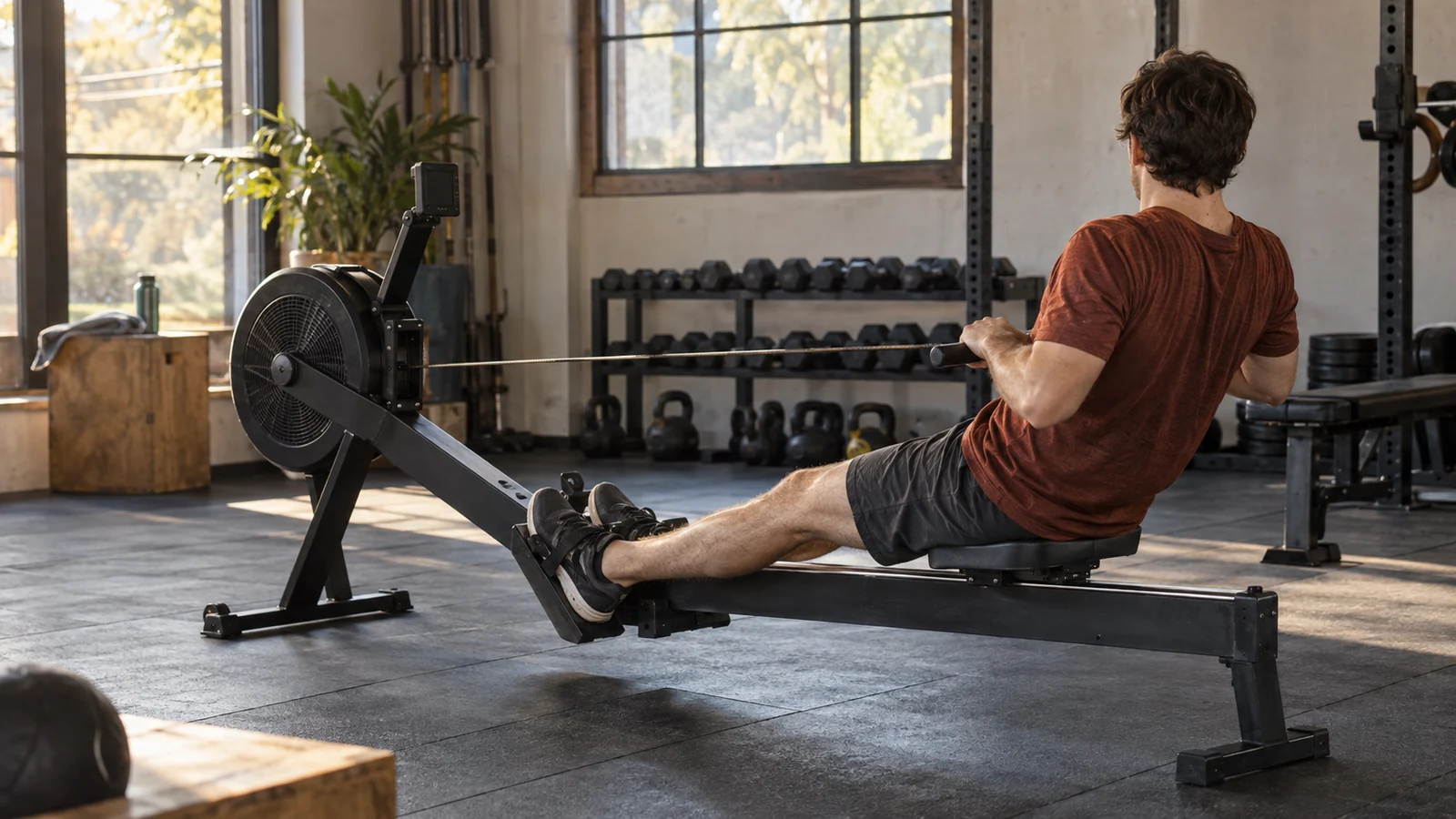
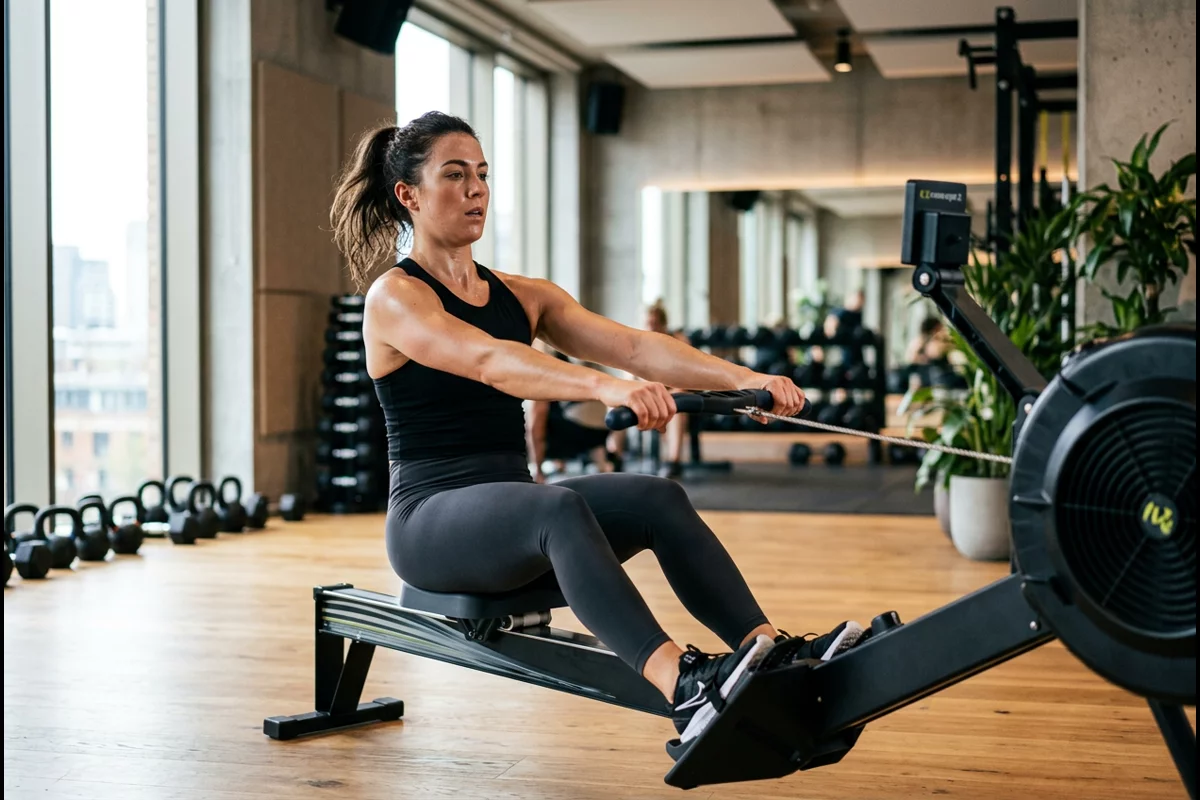
A rowing stroke has four parts: the catch, the drive, the finish and the recovery. The drive is the work, done legs first, then back, then arms; the recovery reverses that order, arms first, then body, then knees. Concept2’s technique page lists the positions below and asks beginners not to pull hard until these feel comfortable.
| Part | What it looks like (Concept2) | Beginner check |
|---|---|---|
| Catch | Arms straight, shoulders level, upper body leaning forward from the hips, shins close to vertical | Shins do not go past vertical |
| Drive | Press with the legs, swing the back through vertical, then pull with the arms; hands move in a straight line | Legs start the stroke, not the arms |
| Finish | Upper body leaning back slightly with core support, legs extended, handle held lightly below the ribs, wrists flat | Shoulders low and relaxed |
| Recovery | Arms extend, body leans forward from the hips, then the knees bend once the hands have passed them | Knees stay down until the hands clear them |

Common mistake: Bending the knees early in the recovery. The handle then has to travel over raised knees, and the next catch starts out of sequence. Let the hands pass the knees first.
Concept2 suggests having someone watch you row and compare your positions with its technique video. If you train alone, our suggestion is to record a short side-on phone video and compare it with the positions in the table.
Takeaway: Learn the order legs, back, arms and back again before adding effort.
The 4-week beginner plan
The table below summarises Concept2’s From Couch to Consistency plan for weeks 1–4: four sessions a week, mixing short intervals, a steady piece and one session that changes pace. The plan was written for Concept2 machines and its free ErgData app. Where a session uses an app feature, we describe the workout itself in plain distances; check the official plan page for the full wording of each day.
| Week and day | Session |
|---|---|
| Week 1, day 1 | 1-2-3-2-1 minutes easy, 1 minute rest between |
| Week 1, day 2 | 2,000 m alternating 90 seconds comfortable and 30 seconds easy or rest |
| Week 1, day 3 | 15 minutes at a steady pace |
| Week 1, day 4 | Three laps of the app’s 1k Real Time Loop, alternating 500 m a little harder and 500 m a little easier (3,000 m) |
| Week 2, day 1 | 8 × (2 minutes moderate, 1 minute easy) |
| Week 2, day 2 | 2 × 2,000 m, 3–5 minutes rest between |
| Week 2, day 3 | Four laps of the 1k loop (4,000 m), short break after two laps if needed |
| Week 2, day 4 | 30 minutes, changing stroke rate between 22 and 26 |
| Week 3, day 1 | Concept2’s Workout of the Day, as hard or easy as you like |
| Week 3, day 2 | 2 sets of 10 × (40 seconds on, 20 seconds rest), easy rowing between sets |
| Week 3, day 3 | 4,000 m at a consistent pace |
| Week 3, day 4 | 1-2-3-4-3-2-1 minute pyramid, 1 minute rest between |
| Week 4, day 1 | 40 minutes |
| Week 4, day 2 | 6 × 500 m, 2 minutes rest |
| Week 4, day 3 | Workout of the Day |
| Week 4, day 4 | 2-minute pieces with open-ended rest; in each rest, 10 reps of a body-weight exercise such as sit-ups, push-ups or air squats (the plan does not set the number of pieces) |
The steady row named in each week: week 1: 15 minutes (day 3); week 2: 30 minutes (day 4); week 3: 4,000 m (day 3); week 4: 40 minutes (day 1).
The Workout of the Day changes daily; Concept2 says its daily workouts run from 20 to 45 minutes.
Concept2 repeats week 4 as week 5 and adds a 5,000 m steady row in week 6, after which the plan hands the choice of formats back to you.

Distance sessions take different amounts of time for different people. Concept2’s pace calculator uses time = split × (distance ÷ 500). As an example with an assumed pace of 2:30 per 500 m, a 2,000 m piece takes 10 minutes and a 4,000 m piece takes 20 minutes. Put your own split from the week 1 steady row into the same formula, or use the time-for-distance method in the pace guide, to know how long each distance day will run.
For the 15-minute row in week 1, the plan says that if you need to ease off at any point, that is fine, as long as you keep moving. The US guidelines set the broader rule for inactive adults: raise how often and how long you are active gradually, over weeks to months.
Takeaway: Use the table as a map of Concept2’s plan and log each session so you can see your own progress week by week.
How hard should each session feel?
Follow the stroke rate and effort each session names, and judge everything else with the talk test. Concept2’s beginner workouts use rates of 20–26 strokes per minute, its general guide calls 24–28 comfortable for steady rows, and the US guidelines define moderate effort as the point where you can talk but not sing. Concept2’s plan asks for variety, with at least two harder efforts a week as a general goal, which it leaves up to you.
The table is Concept2’s general stroke-rate guide, written for all rowers rather than for the beginner plan:
| Stroke rate | Concept2’s general description |
|---|---|
| 18–22 spm | Practising technique, sequence and rhythm; feels more like strength work; long hard pieces at this rate are not recommended |
| 24–28 spm | Comfortable for steady-state work that you can keep with good technique; recommended for longer workouts |
| 30–36 spm | Easier to keep over short distances; best practised in intervals and for racing distances up to 2,000 m |
| 38+ spm | Used by adept crews and athletes for racing and short distances |

Two signals tell you the effort is right. First, the talk test from the US guidelines: at moderate effort you can hold a conversation, while at vigorous effort you can say only a few words before taking a breath. Second, your pace: in Concept2’s second beginner workout you note the pace you settle into during a 10-minute steady row, and the next workout asks you to go only a few seconds per 500 m faster.
Common mistake: Raising the stroke rate to go faster. Concept2 points out that if your pace does not improve when the rate goes up, your technique is slipping; lower the rate until each stroke moves the flywheel well again.
Takeaway: Row each session at the rate it names and at a talking pace unless the session asks for a harder effort.
Rowing machine workouts to rotate in
After the first four weeks, rotate between a few workout formats so that sessions stay varied without becoming random. Concept2 groups its workouts into single time, single distance, intervals and variable intervals, and publishes the short sessions below for different goals.
| Workout (Concept2’s name) | How it runs | Concept2’s stated purpose |
|---|---|---|
| 40“ on / 20“ off | Warm-up: 5 minutes. Main set: 40 seconds hard, 20 seconds easy, for 10 minutes. Cool-down: 5 minutes. | When you only have 20 minutes |
| 4 × 4 minutes | Warm-up: 5–10 minutes. Main set: 4-minute pieces with 2 minutes rest, each a little harder than the last. Cool-down: 5 minutes. | Aerobic intervals |
| Power Tens | Warm-up: easy technique rowing, then a short stretch break. Main set: every minute, 10 strokes with a little more intensity, for about 20 minutes. Cool-down: not timed. | Recovery |
| 500 m AMRAP for two | Warm-up: 10 minutes, shared. Main set: one person rows 500 m while the other does push-ups, air squats and sit-ups, then swap, for 20 minutes. Cool-down: 5 minutes. | Sharing one machine with a friend |
The two-person format is useful practice for a team challenge, where one rower works while the next gets ready. For an event that runs as a relay, the plan for organising a charity challenge event covers shift rotas, counting metres and volunteer roles.
Takeaway: Keep one steady session a week and rotate the rest between interval and technique formats.
Getting ready for a team endurance row
Base each rower’s shift on what their training log shows, not on how many weeks they have trained. Our suggestion for organisers is simple: do not give a beginner a shift longer than the longest continuous piece they have already rowed in training, and keep spare rowers for changeovers.
Use this checklist before you sign up for a shift:
| Check | How to confirm it | Why it matters at an event |
|---|---|---|
| Longest continuous row | Your log from weeks 2–4 of the plan | Sets the longest shift you should take |
| Steady pace | Your average split from a 15–30 minute row | Lets organisers estimate metres per shift |
| Damper setting you train at | The setting on your usual machine, plus its drag factor | Event machines will feel different |
| Changeover practice | A few 500 m AMRAP rounds with a partner | Practises getting on and off the machine quickly |
Your steady split is the number organisers need. With it, they can turn a target distance into hours of rowing and shifts, using the pace and time-for-distance tables. For a long-term individual goal, Concept2’s Million Meter Club gives a sense of scale: rowing four times a week for a year, you need to average just under 5,000 m a session to reach one million metres. More guides on targets and pacing for long efforts sit under endurance challenges.
If your event collects money on site, the explainer on contactless donations at events covers how tap-to-pay readers work; the planning side is in the event planning guides.
Common mistake: Giving new rowers shifts longer than anything they have rowed in training. Match each shift to the rower’s logged longest piece, and keep spare rowers for changeovers.
Takeaway: Bring your longest logged row and your steady split to the team meeting; they decide your shift length.
When this does not apply
The plan and numbers above are general information for healthy adults on an air-resistance rowing machine. Treat them differently in these cases:
- Chronic conditions or symptoms. The US guidelines say people with chronic conditions or symptoms should be under the care of a health care provider and ask a professional about the type and amount of activity that suits them.
- Pregnancy, older age or a long break from exercise. The guidelines include separate advice for these groups; this page does not replace it or a professional’s assessment.
- Other machines. Concept2 wrote this plan for its own rowers, monitors and app. Water, magnetic or hydraulic rowers have different resistance systems and displays, and the damper and drag-factor advice here applies to Concept2 air rowers only.
- Pain during or after rowing. Stop and get it checked; this site does not give injury or medical advice, as explained on the about page.
Takeaway: Use the plan as general information, and follow the official guidance or a professional’s advice if any of these apply.
Method and sources
This page was compiled on October 7, 2026 from Concept2’s public training pages and blog posts and from the US Physical Activity Guidelines for Americans, 2nd edition (2018), which the federal guidelines site still lists as current. Every session in the 4-week table comes from Concept2’s From Couch to Consistency plan; the “how long” chart combines that plan with Concept2’s first workouts and the guidelines’ weekly minutes. We did not test these workouts ourselves, and nothing here is a personal training or medical recommendation. Example times use an assumed pace and are labelled as such. The cover image is an illustration, not a photo of a real event. The site is independent and does not collect donations; see the about page for who runs it. More indoor rowing guides are collected under indoor rowing.
Related reading
- Rowing pace per 500 m chart and conversion formulas: turn your steady split into a target time for any distance.
- How to organize a charity challenge event: plan shifts, roles and counting for a team row.
- Contactless donations at events: how tap-to-pay giving works if your event collects money on site.