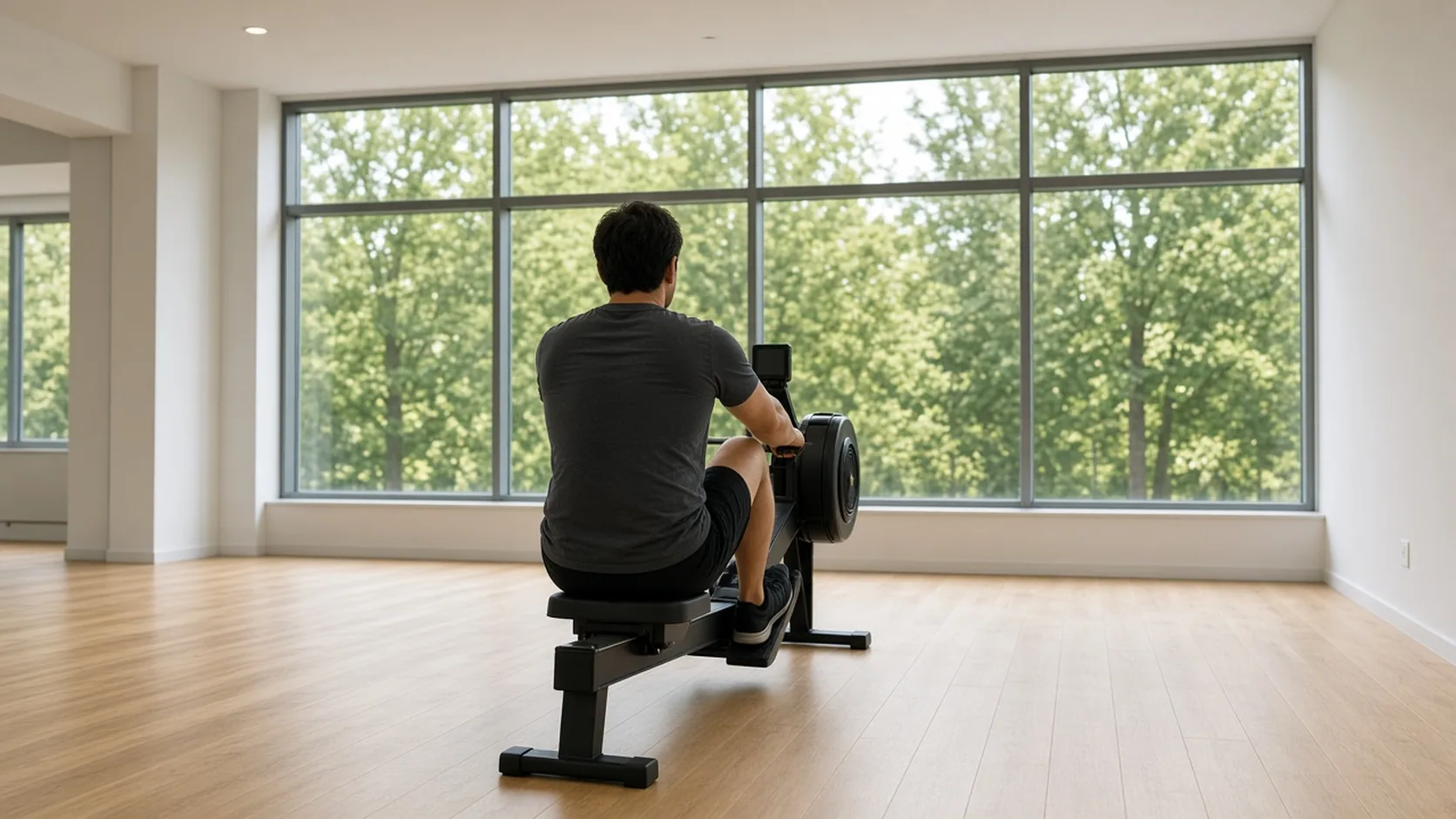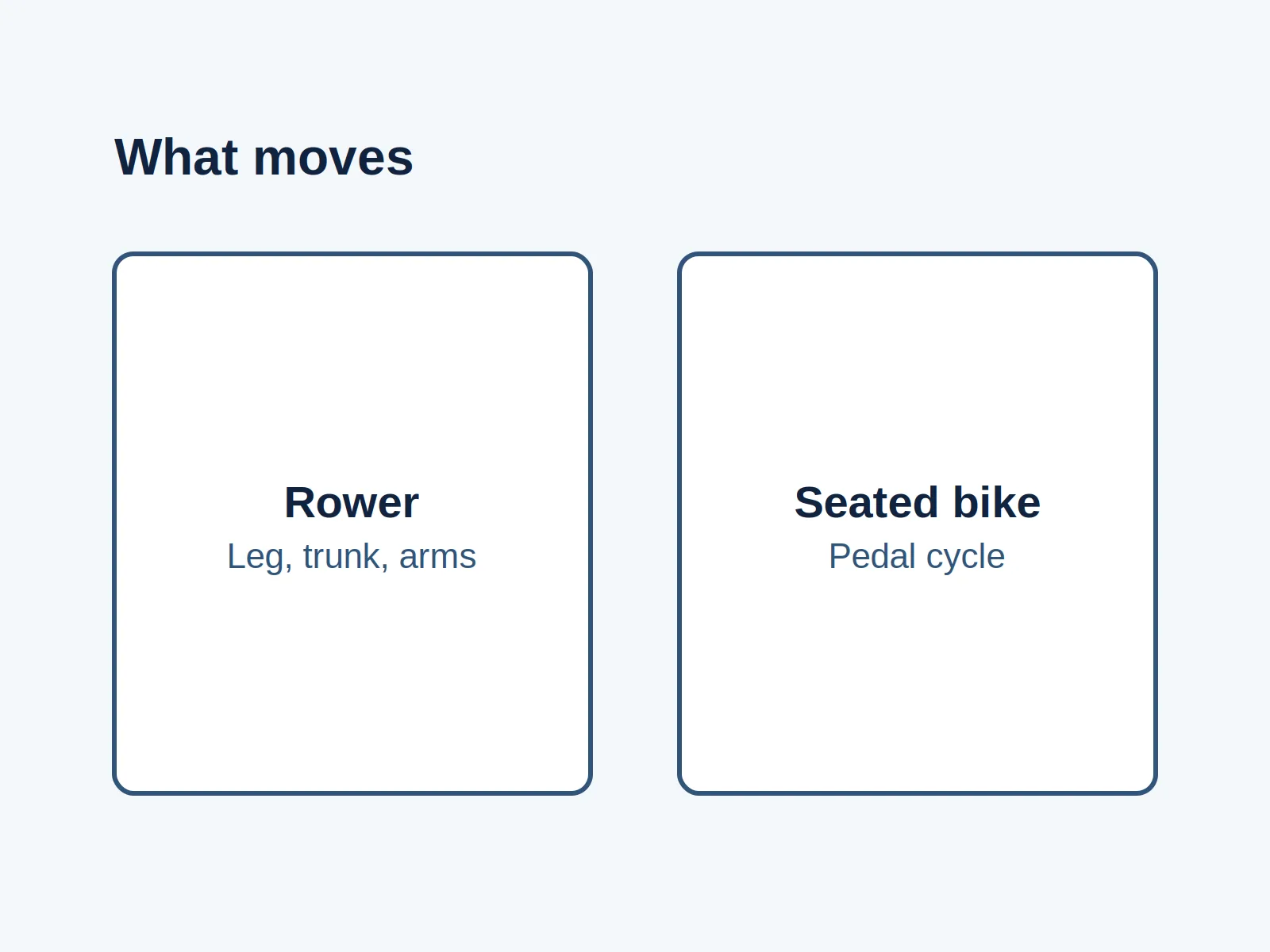
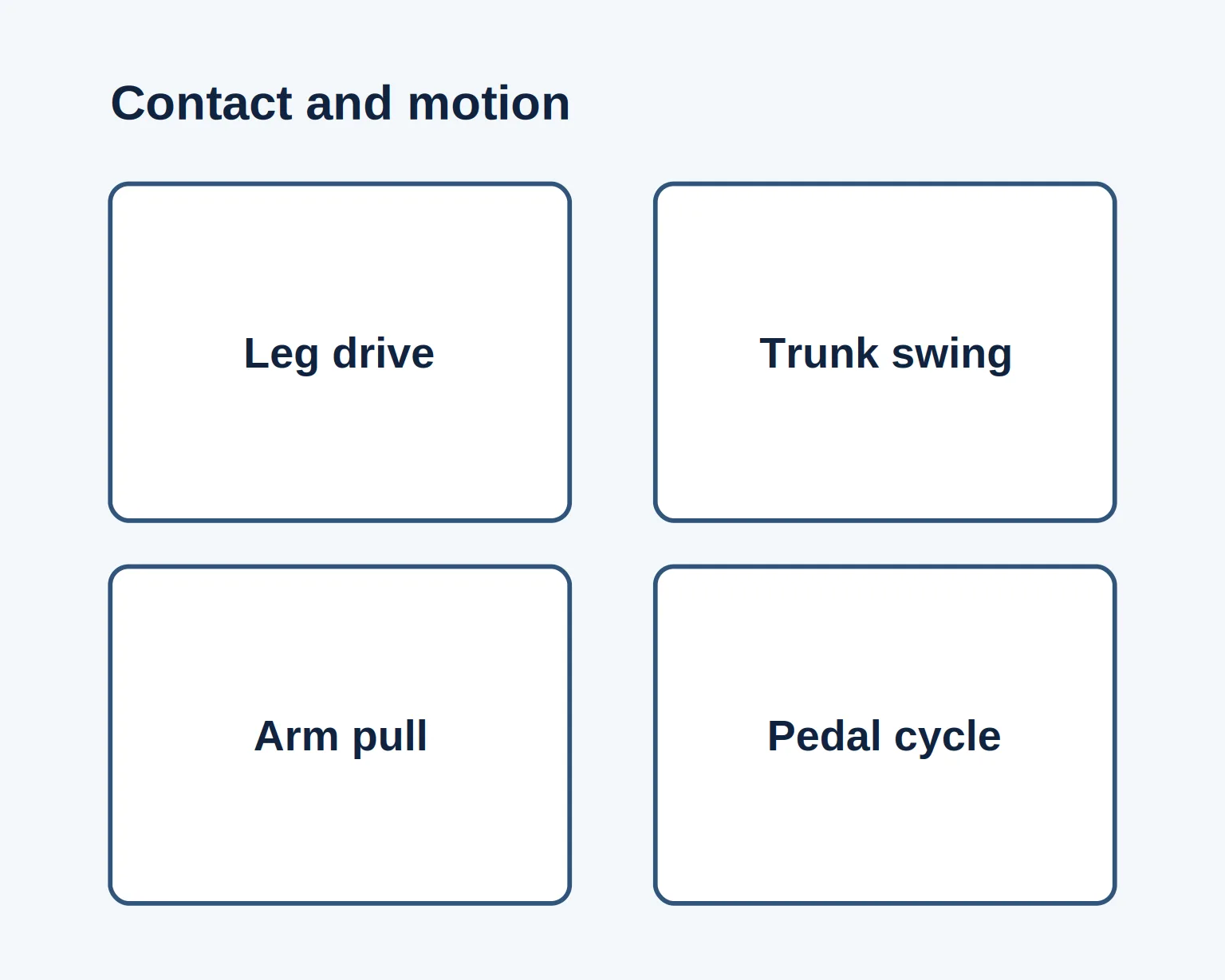
A rowing machine combines a leg drive, trunk movement and arm pull; a seated exercise bike centers the work on repeated pedaling. Neither machine’s calorie display tells you how much force passes through a knee, hip or back. Choose between them by the movement you can repeat with a suitable setup and the kind of endurance session you want to complete.
This rowing machine vs exercise bike comparison concerns a sliding-seat indoor rower and a seated stationary bike. Concept2’s RowErg and BikeErg instructions provide concrete setup examples. Standing cycling classes, recumbent machines and rehabilitation programs require their own guidance.
What a rower and a seated bike load
The useful distinction is the movement and support pattern, rather than a claimed percentage of muscles used. A supported body still has to produce and transmit force.
| Decision point | Sliding-seat rower | Seated exercise bike | Dominant Failure Mode & Prevention |
|---|---|---|---|
| Where the work enters the machine | Feet push against the footplates; the stroke continues through trunk swing and handle pull | Feet drive the pedals while the saddle supports the seated rider | Treating rowing as only an arm exercise: learn the leg–body–arm sequence before chasing output |
| What the upper body does | Trunk and arms contribute to the stroke; the recovery returns the body for the next drive | Hands contact the bars and the trunk maintains the chosen riding position; there is no rowing-style handle pull | Assuming seated cycling has no posture demands: check saddle and handlebar fit on that model |
| What repeats around knees and hips | The seat travels through a catch and leg extension | The pedals carry the legs through repeated cycles | Forcing range to match another person: use the manufacturer’s fit guidance and your comfortable movement range |
| What can limit a longer session | Maintaining stroke coordination and posture across repeated strokes | Maintaining a comfortable seated position and repeatable pedaling | Extending duration before the setup works: establish a repeatable movement before using a longer trial to compare machines |
These are movement observations and planning implications, not measured injury rates. Concept2’s rowing technique guide describes a catch with shins near vertical within a comfortable range, a leg-led drive, and a finish supported by the core. That combination explains why calling rowing “just cardio for the arms” misses much of the task.
For its BikeErg, Concept2’s saddle guidance calls for some knee bend at the furthest pedal position when riding with the ball of the foot on the pedal. The bike therefore needs an individual setup too. A saddle height copied from another rider is not evidence that the position fits you.
Why the calorie number cannot decide joint comfort
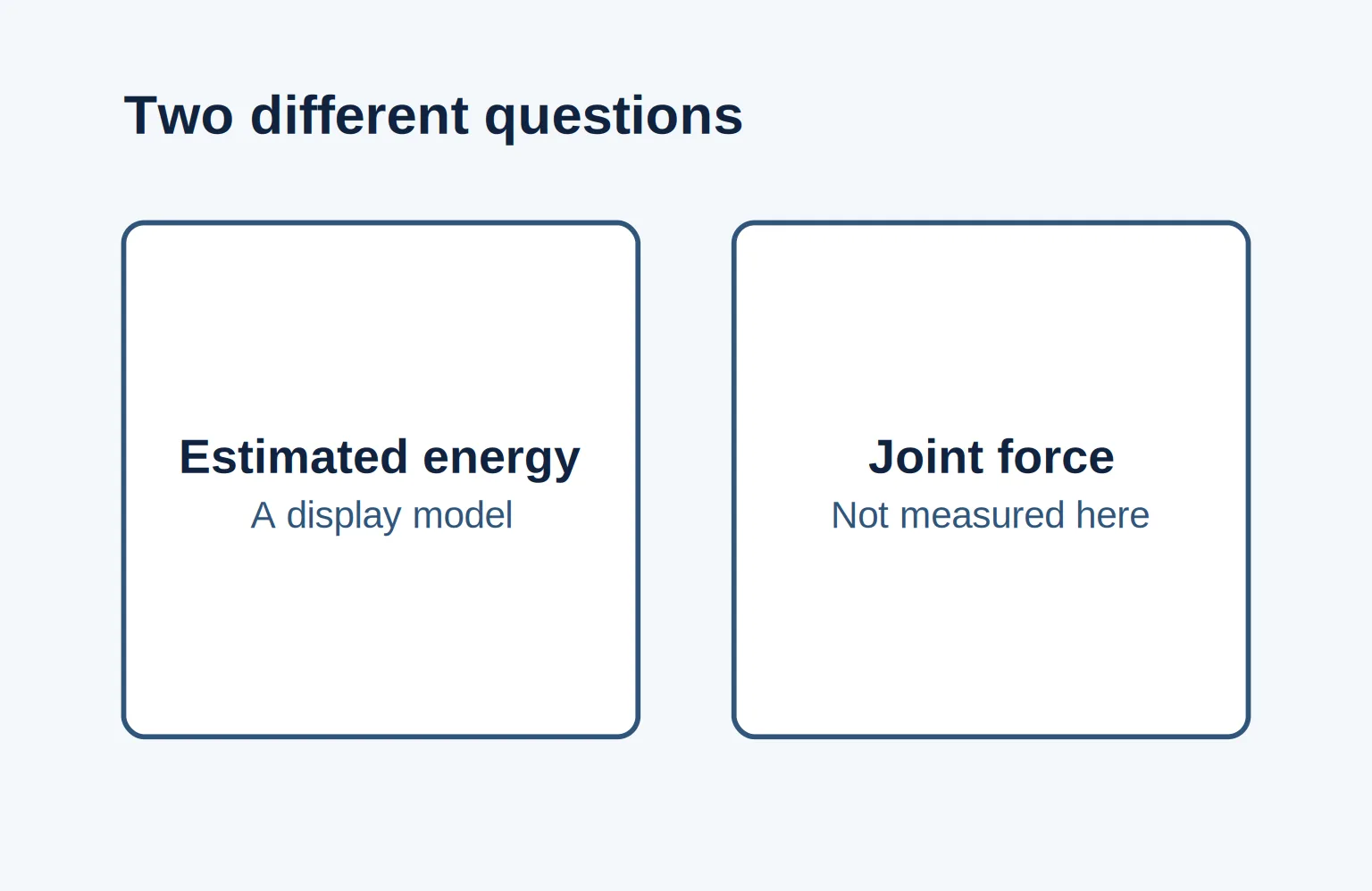
The PM5 instructions state that its calorie calculation uses a 175-pound reference person and direct users to a body-weight calculator. A number on the screen is consequently a model-based energy estimate. Check a different bike’s manual for what its own display assumes.
The inference for this comparison is straightforward: an energy estimate does not identify the forces at individual joints or the way your body shares the load. Matching the rower’s calorie number on a bike cannot establish equal knee loading. Nor does matching heart rate establish equal technique, joint motion or comfort.
Both activities avoid the landing phase of running or jumping, but that does not make either movement free of load. Seat position, resistance, movement range and how you execute the movement still matter. The sources here do not provide a joint-force comparison that would justify naming one machine universally safer.
If pain or a condition is driving the choice, get an assessment suited to that issue rather than using a calorie total as the deciding test. This comparison offers no rehabilitation prescription.
Compare effort before comparing the displays
For a practical comparison, record the machine and its setup, the elapsed time, your perceived effort and whether the movement stayed controlled. Use comparable durations and the same intended effort category. Comparing a hard row with an easy ride answers a different question from comparing two moderate sessions.
Rule of thumb: if either trial reaches 7/10 perceived effort or higher, do not classify both trials as moderate. The CDC’s relative-intensity guidance places moderate effort at 5–6/10 and vigorous effort beginning at 7–8/10. Its speech check distinguishes conversation without singing from being limited to a few words between breaths. These are effort classifications, not thresholds for joint safety.
A beginner also needs time to learn the rower’s sequence; a first awkward attempt is a poor basis for ranking long-session comfort. Use the existing beginner rowing guide for progression and workout formats rather than treating this comparison as a training plan.
One calculation that keeps the units honest
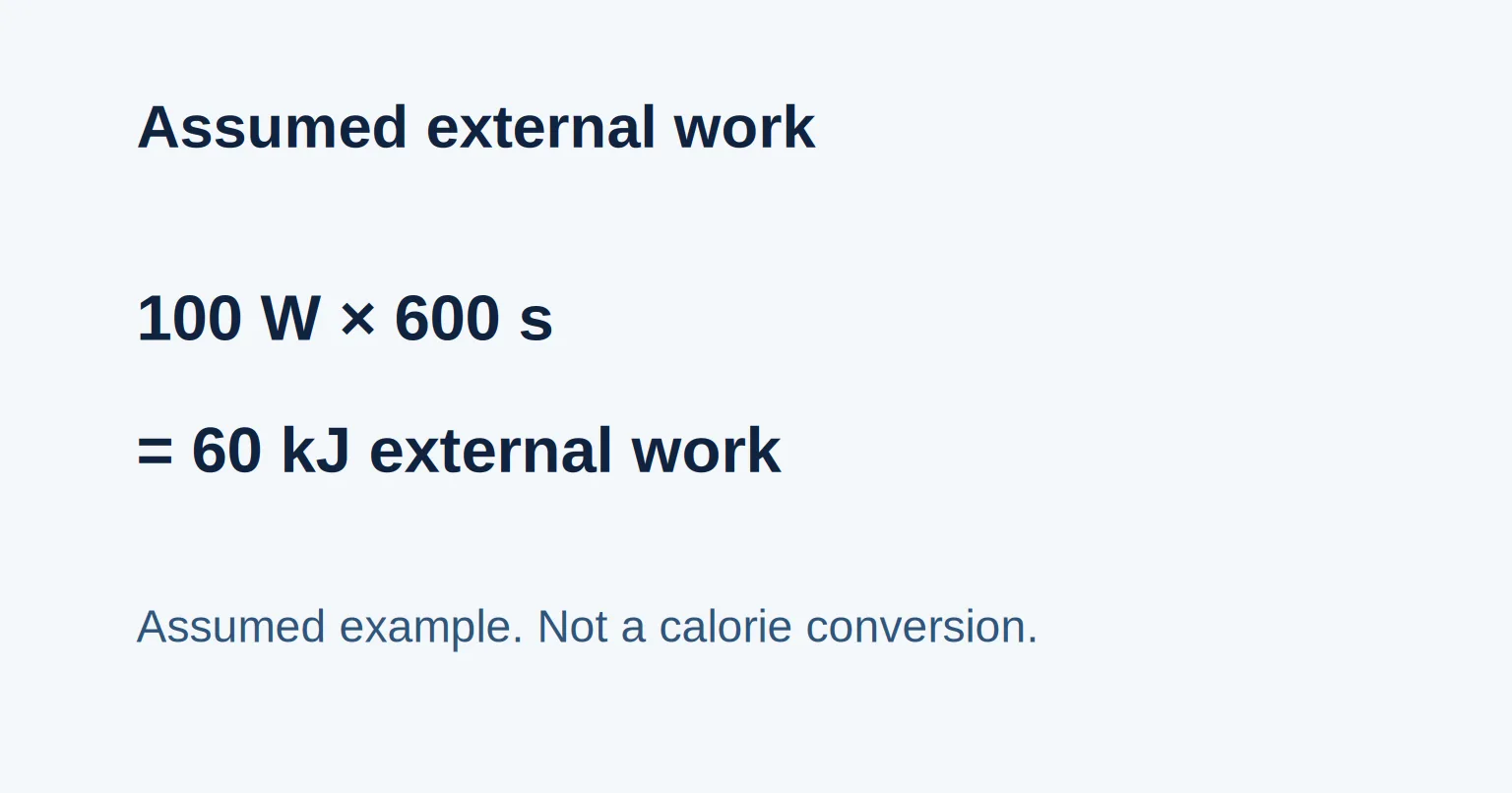
External mechanical work is a separate quantity from estimated metabolic energy. If a device reports average mechanical power over a known duration, the unit relationship is:
External work (kJ) = average power (W) × duration (s) ÷ 1,000.
Illustrative substitution: 100 W × 600 s ÷ 1,000 = 60 kJ of external work.
Both inputs are assumed examples, not measurements from a participant. Watts are joules per second, which is why this calculation produces kilojoules. It does not calculate food Calories, distribute that work among body parts, or establish equivalent effort between two devices. Even equal reported mechanical work would leave the joint-load question unanswered.
When planning a row by distance, use the rowing pace and time-for-distance guide. Its split conversions serve that purpose; there is no reason to reproduce the pace chart or apply a rowing split to a generic exercise bike.
Mixed-machine challenge scores are a separate decision
A challenge can award different credit to different equipment without claiming physiological equivalence. For example, the Concept2 Virtual Team Challenge accepts the listed Concept2 machines and credits BikeErg distance at half its displayed meters. That is a named event’s scoring policy, not proof of equal calorie expenditure or joint loading.
For a private event, state accepted equipment and the scoring unit before participants begin. Do not assume that a generic bike’s distance can be added directly to rowing meters, or that matching calorie displays creates a fair conversion. If the equipment cannot support a defensible shared distance measure, consider reporting participation time separately from device-specific distance.
For your own machine choice, keep the trial record simple: setup, time, effort and movement quality. The useful outcome is a format you can repeat, with a display you understand. More indoor rowing guides cover the next decisions once you have chosen the machine.
Sources and scope
The linked Concept2 and CDC pages were retrieved on October 19, 2026. The comparison table and trial-record suggestions are editorial synthesis; the worked calculation uses labeled assumptions. No calorie-burn trial, joint-force dataset or comparative injury-risk estimate is presented.