Solo endurance challenges depend on one person’s repeatable effort; a continuous team relay also depends on the handoffs, the running clock and who records each turn. Completing the distance is only part of producing a result. A workout can be recorded yet fail an entry rule, sit in the wrong account, or remain absent from the intended board.
This guide focuses on indoor rowing, where a monitor reading, a personal workout and an accepted event result can be different records. The planning distinctions also help an organizer ask better questions about other endurance events, but each organizer’s timing and evidence rules control its results.
Choose the result before choosing shifts
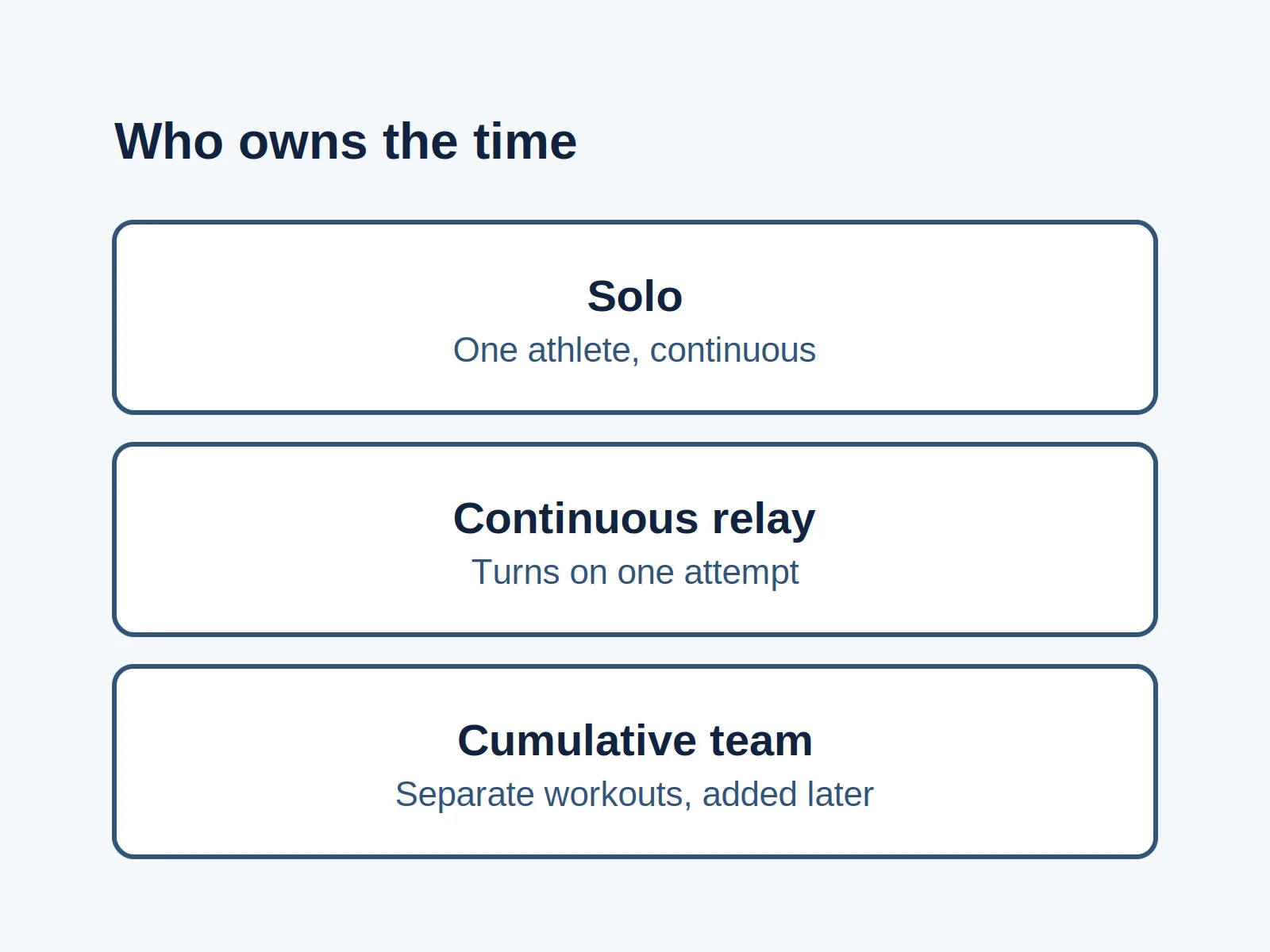
Start by naming what you intend to count. A team adding workouts across a month is not the same operation as athletes exchanging places during one continuing attempt.
| Format | What stays continuous? | Pacing and scheduling problem | Dominant Failure Mode & Prevention |
|---|---|---|---|
| Solo continuous effort | One athlete’s attempt under the event rules | Find an effort that the athlete has practiced over a comparable duration; include any permitted breaks in the clock plan | An opening pace that cannot be maintained: plan from comparable training records rather than a short best effort |
| Continuous team relay | The attempt and its defined clock while athletes change | Match each turn to its athlete, rehearse exchanges and assign recording responsibility | Unbudgeted exchanges or a missing turn record: include changeovers in the schedule and name a recorder |
| Cumulative team challenge | The scoring window and eligibility rules; separate workouts are added | Coordinate eligible sessions and submissions rather than a shared live handoff | Membership mistaken for enrollment: confirm the named challenge’s entry and counting rules |
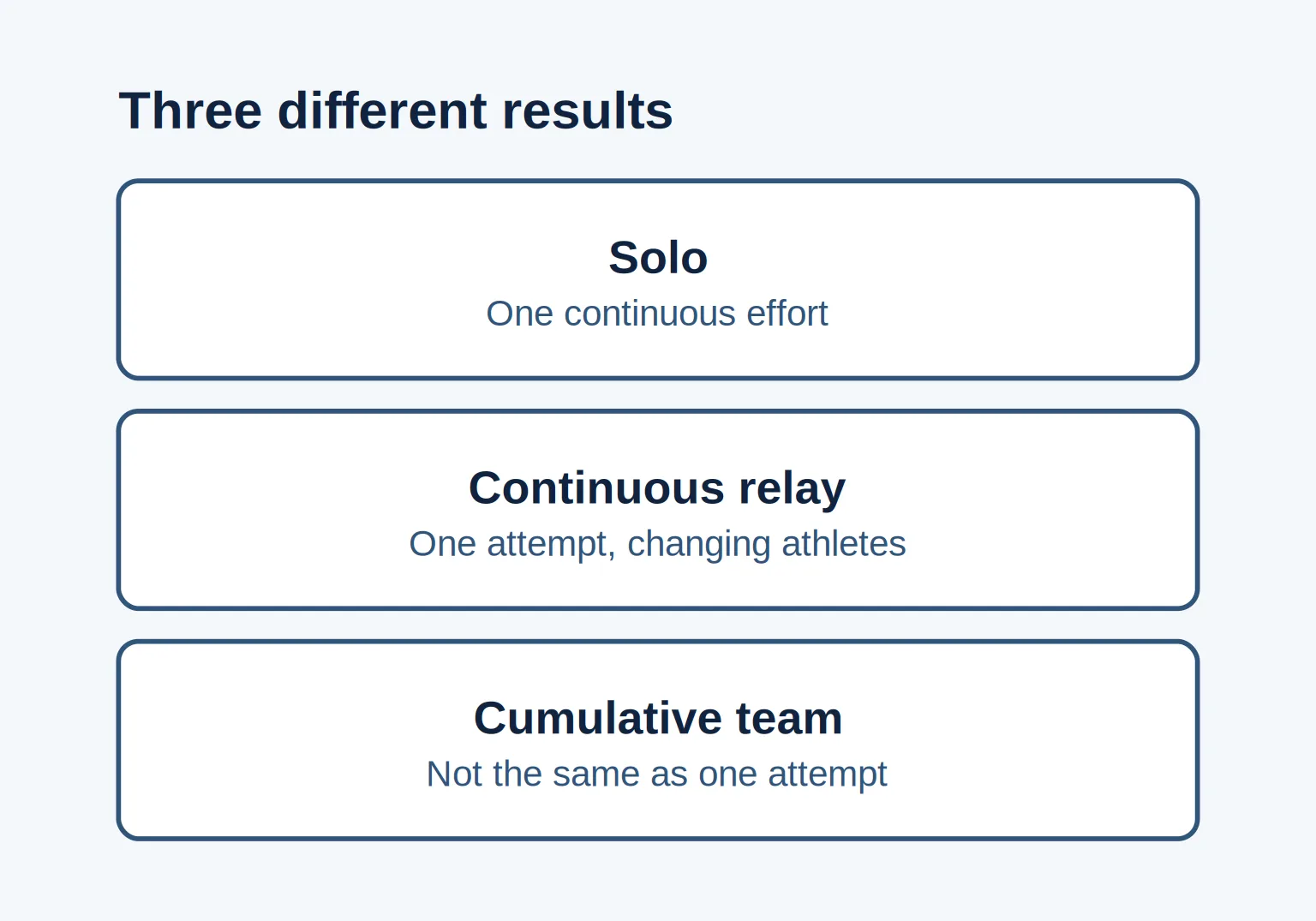
The challenge-versus-race guide handles the broader choice between cumulative events, live races and continuous relays. Once that choice is settled, the practical question becomes whether the people, clock and evidence fit the chosen format.
Build a handoff that preserves the attempt
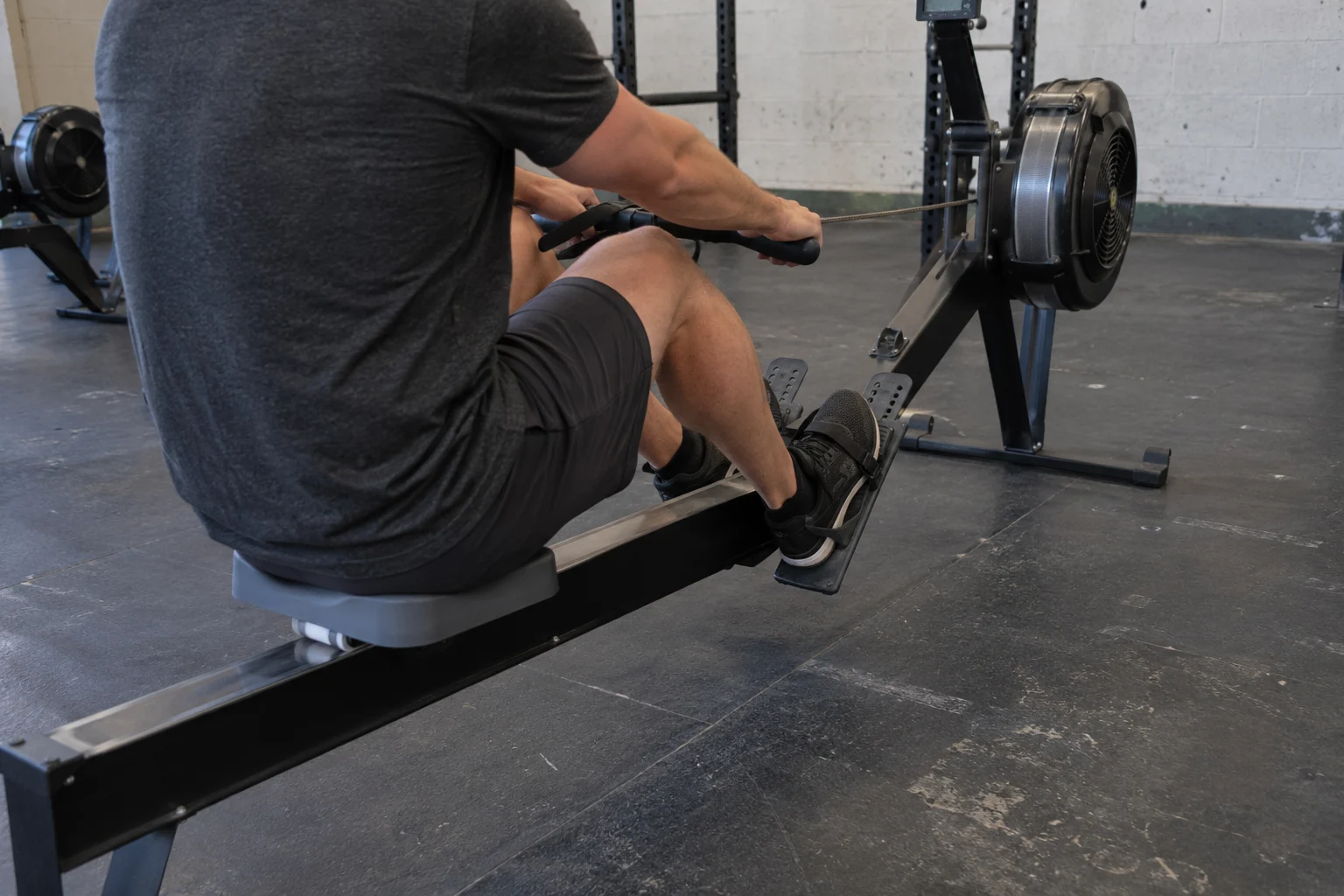
In a relay, agree when the next athlete should be ready, how personal fit settings will be managed, and who owns the changeover record. Rehearse with the actual equipment and follow the machine’s and organizer’s instructions. An exchange that seems simple in conversation can consume time when straps, seating and recording all need attention.
Our planning recommendation is to separate rowing from recording. The outgoing athlete finishes their turn; the incoming athlete prepares for theirs; a named recorder preserves the relevant clock and monitor readings. A short turn is still part of the attempt and should not disappear because the recorder was helping elsewhere.
For an official record, use the exact authority’s requirements. Concept2’s standard team record requirements specify one machine, uninterrupted flywheel movement and a witness-signed turn log recording who rowed, when, and the start and end monitor readings. The page includes further verification and category conditions, including special formats. Those requirements do not automatically apply to every community relay.
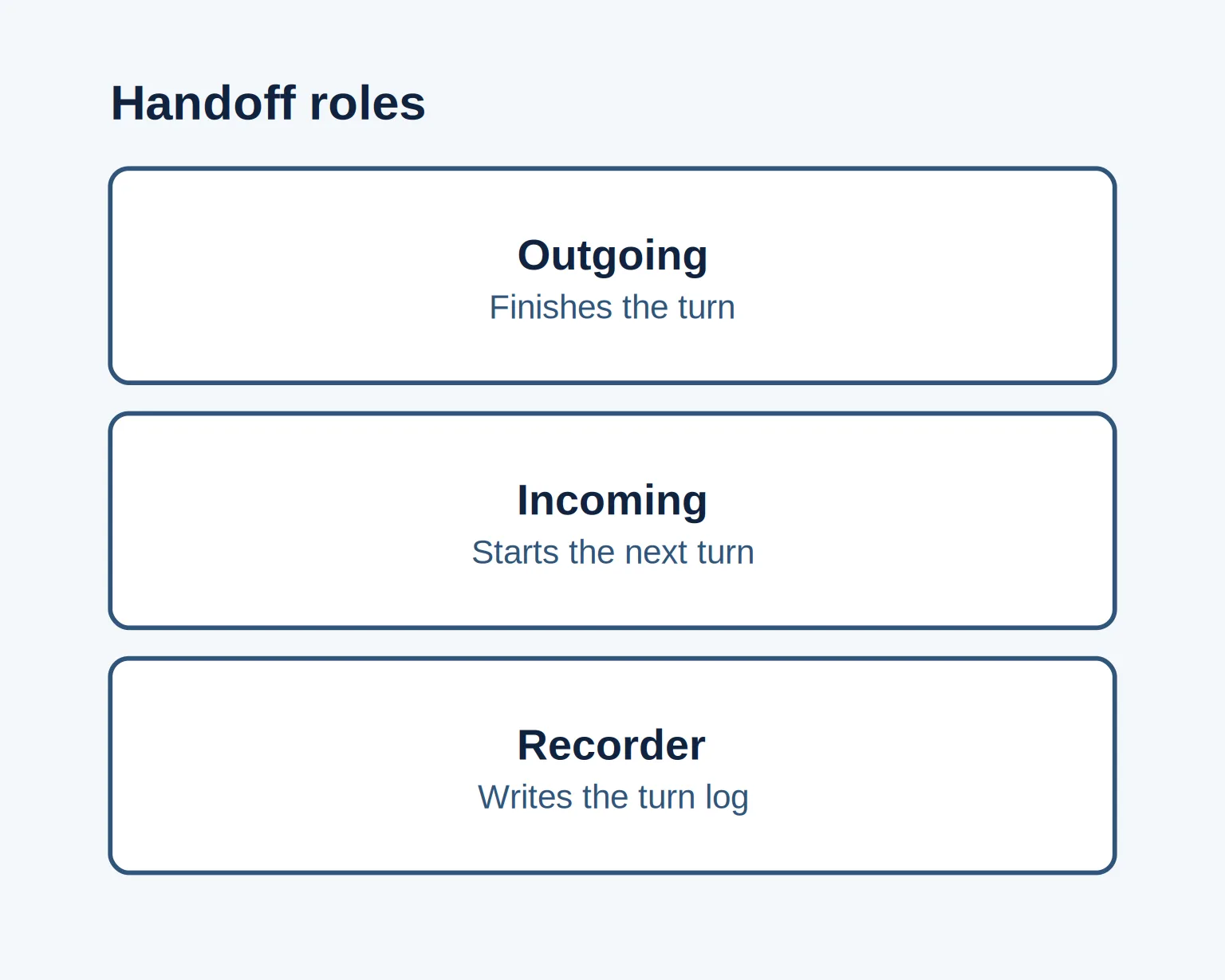
A private challenge should state its own continuity and interruption policy before starting. A large total does not, by itself, establish an official record. The result-verification guide covers evidence options in more detail.
Solo pacing has no replacement athlete
A solo plan needs a pace the participant can sustain over the intended effort, rather than a relay teammate’s fastest shift. Use training records from comparable sessions to estimate moving time. The rowing pace guide explains the split-to-time conversion without requiring a second chart here.
During preparation, keep effort descriptions consistent. The CDC’s intensity guidance uses perceived effort and ability to speak to distinguish moderate from vigorous activity. That is useful vocabulary for comparing sessions; it does not supply a universal all-day pace or a safe shift length.
For a team, different rowers can therefore have different planned turns. For a solo participant, a scheduled rest is still time that needs treatment under the event rules. Decide whether the clock continues during breaks instead of silently reporting moving time as elapsed time.
Check whether the clock budget fits
Relay planning needs more than adding expected rowing times. A simple conservative model adds an allowance for exchanges:
Budgeted elapsed time = estimated moving time + number of handoffs × allowance per handoff.
Illustrative substitution: 50 min + 5 × 20 s = 51 min 40 s.
All inputs are assumed planning numbers, not an observed event. The example assumes six turns, five exchanges, no distance credited during exchanges and no additional breaks. A real machine may continue accumulating some distance during a changeover; a rehearsal can refine the estimate. This model is not an official timing method.
Rule of thumb: if the available clock time is less than the budgeted elapsed time, revise the target or schedule before promising a finish. In this example, a 51-minute booking is shorter than the 51-minute-40-second budget even before adding contingency. Planning for that difference is more credible than assuming the athletes will compensate by rowing faster.
Longer relays need additional allowances for the interruptions they actually expect. Keep these explicit so a venue booking, volunteer rota and advertised finish refer to the same clock. The event-planning guide covers the wider organization work.
How completed work disappears from the result
A missed result can occur at several boundaries. Identifying the boundary helps you choose the right owner for the problem:
| Boundary | What may be missing | What the organizer should establish |
|---|---|---|
| Work to saved record | The session was completed but the intended record was not retained | Which device or log is the primary record and who preserves it |
| Saved record to participant | A shared device or account leaves attribution unclear | Which athlete or team owns each session or turn |
| Participant record to eligible entry | The activity, equipment, enrollment or submission falls outside the rules | The named event’s counting policy and deadlines |
| Eligible entry to visible result | Display or privacy settings differ from the expected board | Which board is intended and who confirms visibility |
| Visible total to accepted performance | The evidence does not satisfy the claimed result | Who checks the required verification before announcing acceptance |
These are editorial categories, not five troubleshooting steps. Concept2’s Logbook help distinguishes workout records from challenge and board requirements. For its cumulative Virtual Team Challenge, the official page distinguishes team membership from challenge enrollment and sets separate entry deadlines. A relay shift sheet cannot replace those requirements.
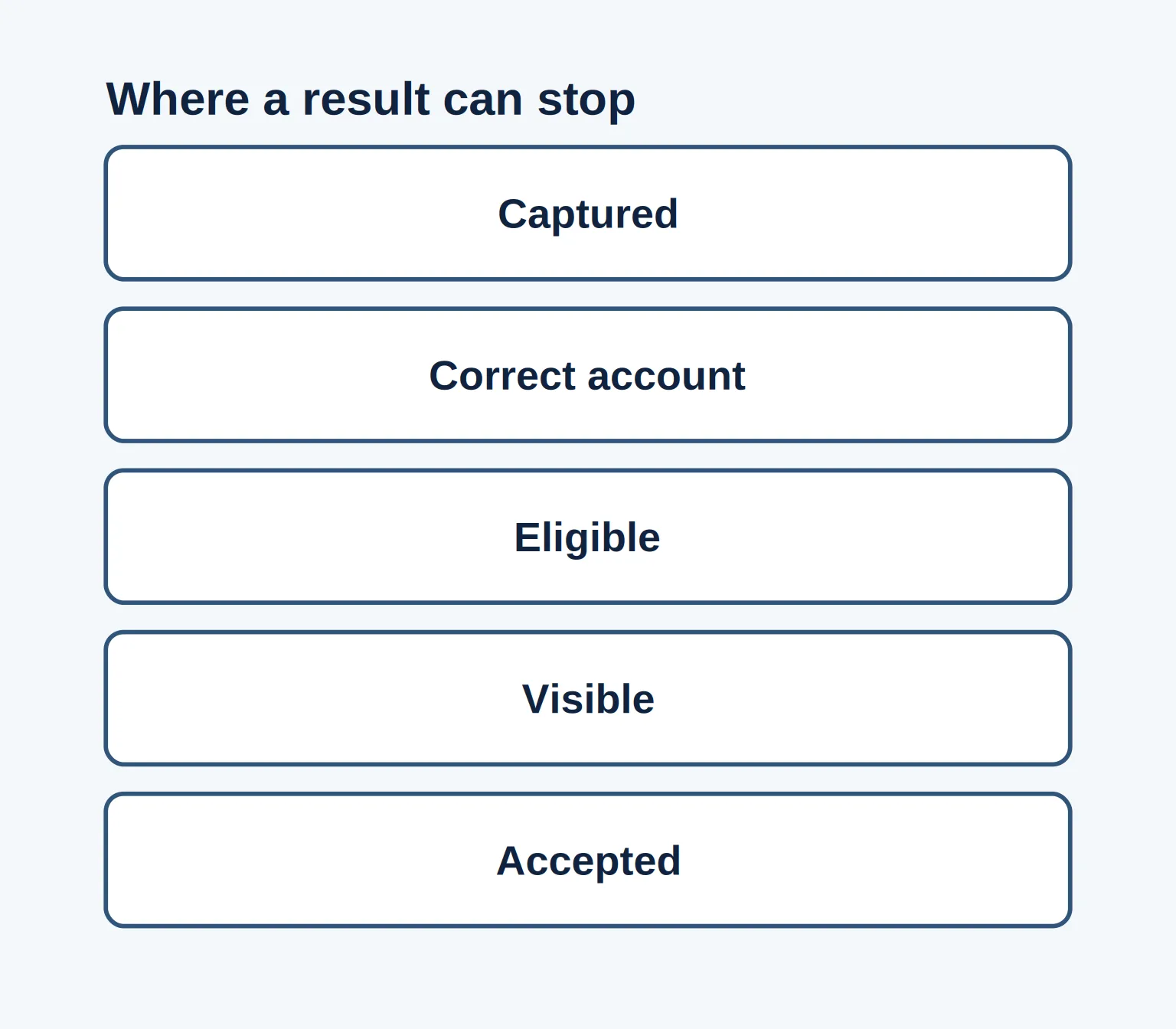
If the workout is already in the Logbook but its challenge meters are missing, use the existing Concept2 missing-metres guide for the diagnostic procedure. Do not enter a duplicate workout simply because the intended board does not show the first one.
Put ownership into the event note
Before sending the invitation, write down the format, the clock, the counted unit and the accepted equipment. Then name the people responsible for the turn log, final monitor record, submission and confirmation of the accepted result. State where the backup record lives and what happens if the attempt is interrupted.
For a solo effort, the same person may perform several of these jobs, but the jobs still exist. For a relay, leaving them implicit makes it easy for everyone to assume someone else saved the result. More endurance challenge guides cover the decisions around this plan.
Sources and scope
The linked official Concept2 and CDC pages were retrieved on October 19, 2026. The comparison, ownership suggestions and scheduling model are editorial planning tools. The time example is hypothetical; no race result, record certification or personal training prescription is claimed.