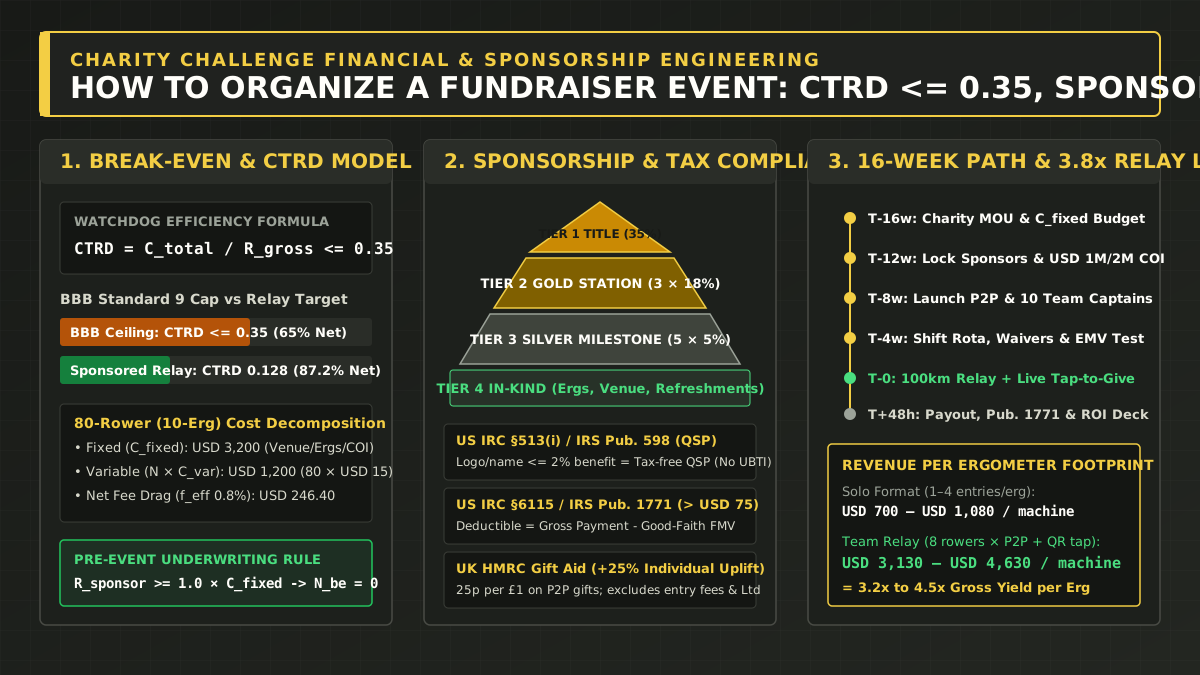
Signing a venue contract or ordering participant shirts before locking in corporate underwriting is a costly structural failure that drains charitable net proceeds when turnout falls short. Organize a fundraiser event around three financial and operational controls: cap your Cost-to-Raise-a-Dollar (CTRD) below USD 0.20–0.35 by separating fixed overhead from per-participant variable costs, underwrite 100% of fixed costs through a 4-tier corporate sponsorship pyramid structured within US IRS Publication 598 / 1771 or UK HMRC Gift Aid rules, and execute a 16-week critical-path schedule using team relay formats that multiply gross revenue per machine footprint by 3.2x to 4.5x.
While our supporting pillar guide on how to organize a charity challenge event over 12 weeks establishes donation routing, volunteer role assignments, and two-person shift meter counting, this guide addresses the financial underwriting math, statutory tax boundaries, and venue unit economics required when hosting a sponsored endurance challenge or community charity event.
Quick financial & compliance specifications
| Parameter | Target benchmark | Governing standard | Operational impact |
|---|---|---|---|
Fundraising Efficiency (CTRD) |
<= USD 0.35 cap; USD 0.15–0.28 relay target |
BBB Wise Giving Standard 9 (<= 35% cap) |
Preserves 65% to 85%+ net charitable yield |
Pre-event sponsorship (R_sponsor) |
R_sponsor >= 1.0 × C_fixed by T-12w |
Pre-Event Sponsorship Coverage Rule | Drives break-even threshold (N_breakeven) to 0 |
US Qualified Sponsorship (QSP) |
Return benefit FMV <= 2%; passive logo/name |
IRC §513(i), 26 CFR §1.513-4, IRS Pub. 598 |
Keeps corporate sponsorships 100% exempt from UBIT |
| US Quid Pro Quo Disclosure | Written notice for gross payment > USD 75 |
IRC §6115, IRC §6714, IRS Pub. 1771 |
Deductible = Gross - FMV; USD 10/gift penalty (<= USD 5,000) |
| US Donor Substantiation | Written acknowledgment for gifts >= USD 250 |
IRC §170(f)(8) and IRS Pub. 1771 |
Must state cash amount and any goods/services FMV |
| UK HMRC Gift Aid Reclaim | +25% (25p per £1; Gross = Net / 0.80) |
HMRC Gift Aid Guidance (Ch. 3) | Individual P2P gifts only; excludes entry fees & companies |
Card Processing Drag (f_proc) |
2.2% + USD 0.30 nonprofit (0.4%–0.8% net) |
Stripe Pricing & FTC Crowdfunding | Optional donor fee-coverage sees 70%–85% opt-in |
| Team Relay Revenue Multiplier | 6–10 rowers/erg (USD 3,130–4,630/erg) |
Concept2 Pace Calculator & Team Rules | Generates 3.2x to 4.5x higher revenue per erg than solo heats |
1. Financial Architecture: Cost-to-Raise-a-Dollar (CTRD) and Break-Even Modeling
Learning how to organize a fundraiser event that delivers real net cash to a beneficiary starts with modeling unit economics before announcing a date or signing a facility lease. Event committees that focus only on gross money collected often discover during post-event reconciliation that venue hire, equipment transport, shirts, and card fees consumed half of the gross receipts.
Watchdog Efficiency Benchmarks (CTRD and Net Charitable Margin)
Charity evaluators measure event fundraising efficiency using Cost-to-Raise-a-Dollar (CTRD) and Net Charitable Margin (%):
CTRD = Total_Event_Expenses (C_total) / Gross_Fundraising_Revenue (R_gross)

Net_Charitable_Margin (%) = (1 - CTRD) × 100% = ((R_gross - C_total) / R_gross) × 100%
Two external benchmarks govern event budgets:
- BBB Wise Giving Alliance Standard 9 Ceiling (
CTRD <= USD 0.35/<= 35%Expense Ratio): Under Standard 9 of the BBB Standards for Charity Accountability, total fundraising expenses must not exceed35%of related contributions (CTRD <= USD 0.35), leaving at least65%net charitable margin (paired with Standard 8’s requirement that at least65%of total expenses fund program activities). In jurisdictions with statutory permit caps—such as Singapore’s30/70rule noted in our 12-week charity challenge guide—the cap tightens to<= 30%(CTRD <= USD 0.30). - Endurance & Peer-to-Peer Event Target (
CTRD <= USD 0.15–0.28/72%–85%+Net Margin): While banquet galas and golf tournaments frequently runCTRDratios ofUSD 0.40–0.55due to catering and course minimums, community athletic challenges (such as a100,000-meteror1,000,000-meterConcept2 indoor rowing, SkiErg, or BikeErg relay) use low-overhead school gyms or rowing clubs. Pairing low venue overhead with upfront corporate sponsorship underwriting and peer-to-peer (P2P) team fundraising yields aCTRDofUSD 0.12 to USD 0.25(75% to 88%net margin).
Decomposing Fixed Overhead (C_fixed) vs Per-Participant Variable Costs (C_var)
When deciding how to plan for a fundraising event, separate every expenditure into one of three mathematical buckets:
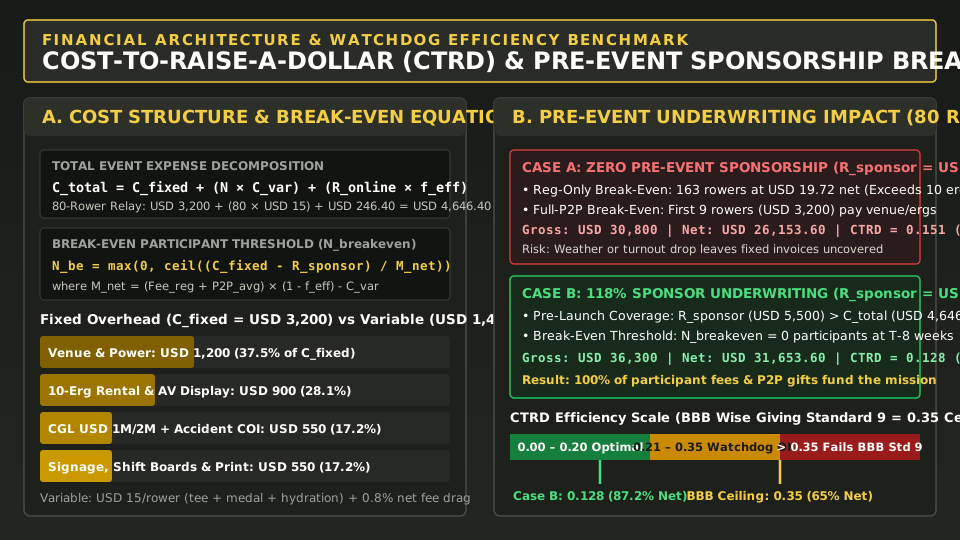
Total_Event_Expenses (C_total) = C_fixed + (N × C_var) + (R_gross_online × f_eff)C_fixed(Fixed Overhead Costs): Commitments that remain constant regardless of headcount—venue lease, Concept2 ergometer rentals, AV projection, liability insurance, permits, and stage banners.C_var(Per-Participant Variable Costs): Costs that scale linearly with registered participants (N)—event shirts, finisher medals, bibs, electrolyte packets, and recovery snacks.f_eff(Net Effective Payment Processing Fee Rate): The fraction of gross online revenue (R_gross_online) retained by card processors after accounting for donors who opt in to cover transaction fees.
| Expense bucket & line item | Typical range (10-erg / 80-rower relay) | Cost drivers & contract checkpoints |
|---|---|---|
Fixed (C_fixed) — Venue Hire, Power & Permits |
USD 500 – USD 2,500 (USD 0 in-kind) |
10–12h booking (2h setup + 8h 100 km relay + 1.5h teardown), HVAC, 20A AV circuits, and municipal park/street permits if outdoors. |
Fixed (C_fixed) — Concept2 Ergometers & AV |
USD 400 – USD 1,800 (USD 0–300 loan transit) |
8–12 Concept2 RowErg/SkiErg/BikeErg units (USD 40–95/machine rental or van transit insurance), USB/Ethernet hub for ErgRace display, projector, and PA. |
Fixed (C_fixed) — CGL & Accident Insurance |
USD 250 – USD 750 (1-day endorsement) |
Certificate of Insurance (COI) naming venue as Additional Insured with USD 1,000,000 per occurrence / USD 2,000,000 aggregate CGL + USD 10,000–25,000 Participant Accident medical cover. |
Fixed (C_fixed) — Signage & Shift Boards |
USD 200 – USD 650 |
Value-neutral sponsor banners (IRS Pub. 598), erg lane signs, QR/NFC table placards, and two-person shift logsheets. |
Variable (C_var) — Shirt, Medal or Bib |
USD 8.00 – USD 18.00 per participant |
Screen-printed tee (USD 6.50–12.00), medal/lanyard (USD 2.50–5.00), plus 10% size buffer. Keep below IRS low-cost token thresholds. |
Variable (C_var) — Hydration & Fuel |
USD 3.00 – USD 7.00 per participant |
Water, electrolytes, bananas, and bagels across 8 hours of 20-minute relay shifts. |
Variable (f_eff) — Card & Platform Fees |
2.2%–2.9% + USD 0.30 (0.4%–0.8% net) |
Verified 501(c)(3) rate on Stripe is 2.2% + USD 0.30 (2.9% + USD 0.30 standard). Optional donor fee-coverage checkboxes achieve 70%–85% opt-in. |
The Pre-Event Sponsorship Coverage Rule & Break-Even Formula
Engineering Rule of Thumb (Pre-Event Sponsorship Coverage Rule): Never rely on day-of ticket sales or uncollected participant pledges to pay the venue or equipment supplier. Lock in corporate cash and in-kind sponsorships (
R_sponsor) equal to at least100%of fixed overhead (R_sponsor >= 1.0 × C_fixed)—and ideally110% to 118%of total budgeted expenses (R_sponsor >= 1.15 × C_total)—byT-12 weeks, before public registration opens atT-8 weeks.
Calculate the minimum participant headcount required to avoid a deficit using the Break-Even Registration Threshold (N_breakeven):
Net_Margin_per_Participant (M_net) = (Fee_reg + P2P_avg) × (1 - f_eff) - C_var

N_breakeven = max(0, ceil((C_fixed - R_sponsor) / M_net))
Where C_fixed is fixed overhead (USD), R_sponsor is confirmed pre-event corporate sponsorship (USD), Fee_reg is per-participant entry fee (USD), P2P_avg is average P2P donations raised per participant (USD), f_eff is net unpaid processing fee fraction, and C_var is physical variable cost per participant (USD).
If R_sponsor = 0 and you evaluate registration-only solvency (P2P_avg = 0), a USD 35 entry fee with USD 15 variable cost and 0.8% fee drag nets only USD 19.72 per rower toward fixed costs. Covering USD 3,200 in fixed costs from entry fees alone would require ceil(3,200 / 19.72) = 163 rowers—exceeding the physical capacity of a 10-ergometer venue.
Worked Calculation Example: 80-Rower (10 Teams × 8 Rowers) 100 km Relay Budget
Consider a conditional planning model for an 80-participant (10 teams × 8 rowers) 100,000-meter Concept2 indoor rowing relay governed by local supplier quotes and nonprofit card rates:
- Fixed Overhead (
C_fixed):USD 3,200.00(USD 1,200gym lease +USD 900ten-erg rental/transit +USD 550USD 1M/2MCGL & accident COI +USD 550banners/shift boards). - Variable Physical Costs (
C_var):USD 15.00per rower (USD 11tee/medal +USD 4hydration) =80 × USD 15.00 = USD 1,200.00. - Online Registration & P2P Revenue (
R_gross_online):USD 35.00entry fee (USD 2,800.00across 80 rowers) +USD 350.00average P2P raised per rower (USD 28,000.00across 80 rowers) =USD 30,800.00. - Net Unpaid Fee Drag (
f_eff = 0.008):USD 30,800.00 × 0.008 = USD 246.40(with75%of donors covering fees). - Total Event Expenses (
C_total):USD 3,200.00 + USD 1,200.00 + USD 246.40 = USD 4,646.40.
| Financial metric | Case A: Unsponsored (R_sponsor = USD 0) |
Case B: Sponsored (R_sponsor = USD 5,500) |
Structural advantage |
|---|---|---|---|
Pre-event corporate sponsorship (R_sponsor) |
USD 0.00 |
USD 5,500.00 (118.4% of C_total) |
+USD 5,500.00 locked before T-8w |
Registration-only break-even (P2P = 0) |
163 rowers (USD 3,200 / USD 19.72) |
0 rowers (C_fixed - R_sponsor < 0) |
Eliminates ticket-volume dependency |
Full-P2P break-even (M_net = USD 366.92) |
9 rowers (USD 3,200 / USD 366.92) |
0 rowers (solvent before Day 1) |
First 9 rowers’ gifts fund mission, not overhead |
Gross fundraising revenue (R_gross) |
USD 30,800.00 |
USD 36,300.00 |
+17.9% gross receipts |
Total event expenses (C_total) |
USD 4,646.40 |
USD 4,646.40 |
Fixed and variable costs unchanged |
| Net charitable proceeds transferred | USD 26,153.60 |
USD 31,653.60 |
102.8% of all participant & P2P money |
Cost-to-Raise-a-Dollar (CTRD) |
USD 0.151 (15.1%) |
USD 0.128 (12.8%) |
Beats BBB <= USD 0.35 cap (87.2% net margin) |
Takeaway: Separate fixed overhead (C_fixed) from per-participant variable costs (C_var), and lock corporate sponsorships (R_sponsor >= 1.0 × C_fixed) before opening registration so N_breakeven drops to zero and CTRD stays well below USD 0.35.
2. Corporate Sponsorship Pyramid Valuation and Statutory Tax Compliance (US IRS & UK HMRC)
Planning a sponsored fundraiser requires packaging venue visibility into concrete sponsorship tiers while structuring deliverables so they do not trigger US Unrelated Business Income Tax (UBIT), IRS Quid Pro Quo penalties, or invalidated UK Gift Aid claims.
Designing a 4-Tier Corporate Sponsorship Pyramid (USD 5,500–USD 10,000 Target)
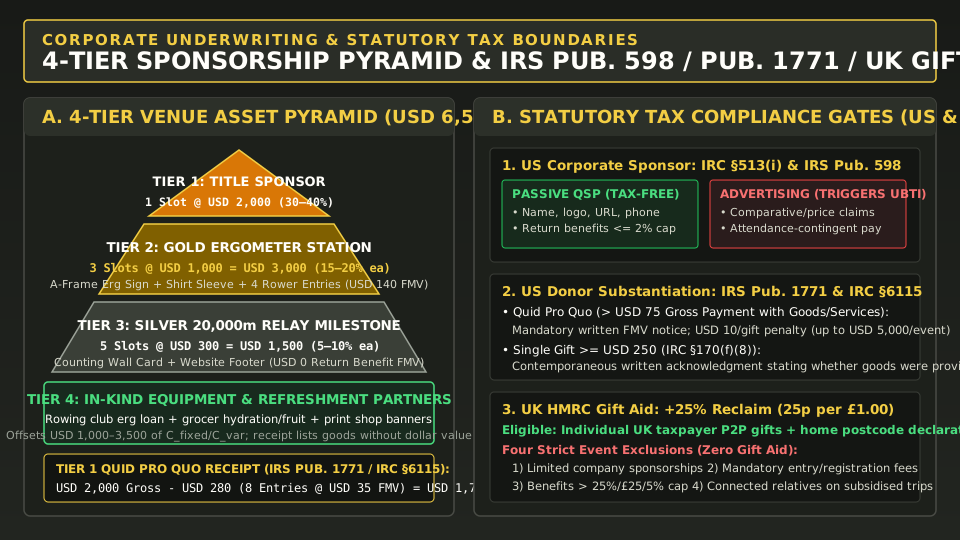
Anchor a 4-Tier Corporate Sponsorship Pyramid to physical and digital assets at the venue: the main stage header and live ErgRace leaderboard, individual Concept2 ergometer stations, 20,000-meter milestone cards on the counting wall, and in-kind equipment or refreshment stations.
| Sponsorship tier & slots | Budget share & pricing (USD 6,500 cash model) |
Venue & digital deliverables | Tax & receipt treatment (IRS Pub. 598 & Pub. 1771) |
|---|---|---|---|
Tier 1 — Title / Presenting Sponsor (1 exclusive slot) |
30%–40% (1 × USD 2,000 = USD 2,000) |
“[Event] presented by [Sponsor]” on stage banner, P2P header, and ErgRace screen; 1 corporate 8-rower relay entry; remarks recognition. |
Passive name/logo is a tax-free QSP (IRC §513(i)). Deduct 8 entries × USD 35 = USD 280 FMV (> 2% cap) on the IRS Pub. 1771 Quid Pro Quo receipt: USD 1,720 deductible gift. |
Tier 2 — Gold / Ergometer Station (2 to 4 slots) |
15%–20% each (3 × USD 1,000 = USD 3,000) |
A-frame floor sign at 2–3 Concept2 erg stations; logo on shirt sleeves and shift board; 4 rower entries (USD 140 FMV). |
Keep signs limited to logo, value-neutral product line, and URL/phone without comparative claims (IRS Pub. 598). Issue Quid Pro Quo receipt for USD 1,000 - USD 140 FMV = USD 860 deductible. |
Tier 3 — Silver / Relay Milestone (5 to 8 slots) |
5%–10% each (5 × USD 300 = USD 1,500) |
Logo on one 20,000 m card on the counting wall, website footer, and thank-you post. |
Zero return benefits (USD 0 FMV, <= 2% safe harbor). 100% (USD 300) qualifies as a tax-free QSP and full charitable receipt (or IRC §162 business expense). |
Tier 4 — In-Kind Partner (3 to 6 local partners) |
Offsets USD 1,000–3,500 of cash C_fixed / C_var |
Rowing club/CrossFit loaning 8–10 RowErgs; grocer donating fruit/bagels; printer donating shift sheets and banners. |
Under IRS Pub. 1771, donated property receipts describe goods without stating a dollar value. Loaning equipment/venue (partial interest) is non-deductible; outright consumable gifts qualify. |
US Corporate Sponsorship Tax Rules: IRC §513(i) and IRS Publication 598 (QSP vs UBTI)
For a US 501(c)(3) organization, a corporate sponsorship payment is exempt from federal Unrelated Business Income Tax (UBIT / UBTI) only when it qualifies as a Qualified Sponsorship Payment (QSP) under IRC §513(i), Treasury Regulation 26 CFR §1.513-4, and IRS Publication 598. As summarized in IRS Advertising or Qualified Sponsorship Payments?, a QSP is a business payment where there is no arrangement or expectation of any substantial return benefit other than passive use or acknowledgment of the sponsor’s name, logo, or product lines.
Three statutory rules govern sponsorship agreements:
- The
2%Substantial Return Benefit Disregard Safe Harbor (26 CFR §1.513-4(b)): If the aggregate fair market value (FMV) of all return benefits provided to the sponsor (other than passive name/logo acknowledgment) is<= 2%of the total sponsorship payment, the return benefits are completely disregarded and100%of the payment is a tax-freeQSP. When return benefits exceed2%, only the payment amount exceeding theFMVof the substantial return benefits is a tax-freeQSP, while theFMVportion is evaluated forUBTIand deducted on the Quid Pro Quo receipt. - Permitted Acknowledgment vs Prohibited Advertising (
26 CFR §1.513-4(c)(2)(v)): Displaying a sponsor’s logo, general phone number, street address, home-page URL, value-neutral product descriptions, or free samples at the venue is tax-free acknowledgment. Including advertising—qualitative or comparative language (“Best physical therapy clinic in Chicago”), price or discount information (“Save 20% with code ROW20”), endorsements, or calls to purchase—stripsQSPprotection from that space and subjects net advertising income to21%federal corporateUBITif regularly carried on. - Exclusive Sponsor vs Exclusive Provider & Contingent Payments (
IRC §513(i)(2)(B)): Naming a company “Official Hydration Sponsor” is a tax-freeQSPacknowledgment, whereas a contract clause banning competing beverages from the venue (“Exclusive Provider”,26 CFR §1.513-4(c)(2)(vi)(B)) is a substantial return benefit. UnderIRC §513(i)(2)(B)(i), any corporate payment contingent upon attendance, ratings, or pageviews (such asUSD 10 per registered rowerfrom a corporate sponsor) is disqualified from theQSPsafe harbor.
| Deliverable or contract clause | Statutory classification (IRC §513(i)) |
Tax consequence | Compliant operational fix |
|---|---|---|---|
| Logo, non-promotional slogan, phone, and URL on banners/webpage | Permitted Acknowledgment (QSP) |
USD 0 UBIT; 100% tax-exempt |
Use “Ergometer Station Sponsor: [Name] — [URL]”. |
| Static product display or free sample handout at venue table | Permitted Acknowledgment (QSP) |
USD 0 UBIT; value-neutral display |
Distribute free electrolyte samples without price sheets. |
| Comparative claims, pricing, or promo codes (“Use code ERG15 for 15% off”) | Prohibited Advertising (26 CFR §1.513-4) |
Net ad income subject to 21% UBIT |
Remove comparative claims, prices, and discount codes. |
| “Official Energy Drink Sponsor” vs banning competing drinks at venue | Exclusive Sponsor = QSP | Exclusive Provider = Not QSP |
Exclusive Provider FMV excluded from QSP if > 2% |
Grant category recognition without venue sales exclusivity. |
| Payment contingent on turnout (“USD 15 per registered athlete”) | Disqualified Contingent Payment | Fails QSP safe harbor (IRC §513(i)(2)(B)(i)) |
Contract as a fixed grant (USD 1,500 flat sponsorship). |
US Donor Substantiation & Quid Pro Quo Rules (IRS Publication 1771 & IRC §6115)
Two federal statutes in IRS Publication 1771 (Rev. 11-2023) govern event receipts:
- Quid Pro Quo Contributions Exceeding
USD 75.00(IRC §6115&IRC §6714): Whenever a donor makes a single payment in excess ofUSD 75.00that is partly a charitable gift and partly for goods or services (such as a VIP entry package with a catered meal or a sponsorship tier including paid race entries), the charity must provide a written disclosure stating that only the excess above the fair market value (FMV) is deductible and giving a good-faithFMVestimate:
Deductible_Charitable_Receipt_Amount = max(0, Gross_Payment - FMV_Goods_and_Services)Critical Statutory Trap (
Gross Payment > USD 75Trigger): TheUSD 75.00trigger inIRC §6115applies to the gross payment, not the net gift. If a participant paysUSD 85.00for an entry that includes aUSD 35.00dinner and gear bundle, the net gift isUSD 50.00(underUSD 75), yet written disclosure is mandatory because theUSD 85.00gross payment exceedsUSD 75.00. UnderIRC §6714, non-disclosure carries a penalty ofUSD 10per contribution, up toUSD 5,000per event.
- Contemporaneous Written Acknowledgment for Gifts
>= USD 250.00(IRC §170(f)(8)): Donors cannot deduct any single gift ofUSD 250.00or more without a written acknowledgment naming the charity, stating the cash amount (or describing donated property without dollar valuation), and stating whether goods or services (FMV) were provided. Issue all acknowledgments by January 31 following the tax year. - Mandatory Registration Fees (
Deductible = USD 0): A standardUSD 35.00entry fee that equals or is less than theFMVof participating generatesUSD 0charitable deduction; only voluntary payments exceedingFMVor pure P2P donations (USD 0 FMV) are deductible.
UK HMRC Gift Aid Compliance (+25% Uplift vs 4 Exclusions)
For UK charity challenges, HMRC Gift Aid guidance (Chapter 3) lets charities reclaim basic-rate tax (20% of gross) on eligible individual gifts:
Gross_Pre_Tax_Gift = Net_Individual_Donation / (1 - 0.20) = Net_Individual_Donation × 1.25

HMRC_Gift_Aid_Reclaim = Net_Individual_Donation × (20 / 80) = 0.25 × Net_Individual_Donation (+25%)
To claim 25p per £1.00 donated, each individual P2P sponsor must complete a Gift Aid declaration stating their full name, home address and UK postcode (work addresses and joint “Mr & Mrs” lines fail audit), and confirmation that they have paid sufficient UK Income Tax or Capital Gains Tax to cover the 25p/£1 reclaim. Enforce four strict HMRC exclusions:
- Corporate Donations Excluded: Limited company payments cannot claim Gift Aid; companies deduct qualifying donations directly against Corporation Tax.
- Registration Fees & Standard Tickets Excluded: Mandatory challenge entry fees buy a right to participate and never qualify for Gift Aid.
- Donor Benefit Limits (
25% / £25 / 5%Cap): Gift Aid is lost if donor benefits exceed25%on gifts up to£100,£25on gifts of£101–£1,000, or5%(capped at£2,500) on gifts over£1,000. - Connected Persons on Subsidised Challenges: If the charity pays any participant travel or accommodation costs, donations from close relatives (connected persons) cannot claim Gift Aid unless the participant reimburses
100%of their costs.
Takeaway: Anchor sponsorships to a 4-tier venue pyramid, keep banners value-neutral under IRS Publication 598, issue IRS Publication 1771 Quid Pro Quo disclosures on all gross payments > USD 75, and restrict UK Gift Aid (+25%) to voluntary individual P2P gifts.
3. How to Host a Charity Event: 16-Week Critical Path & Team Relay Revenue Multipliers
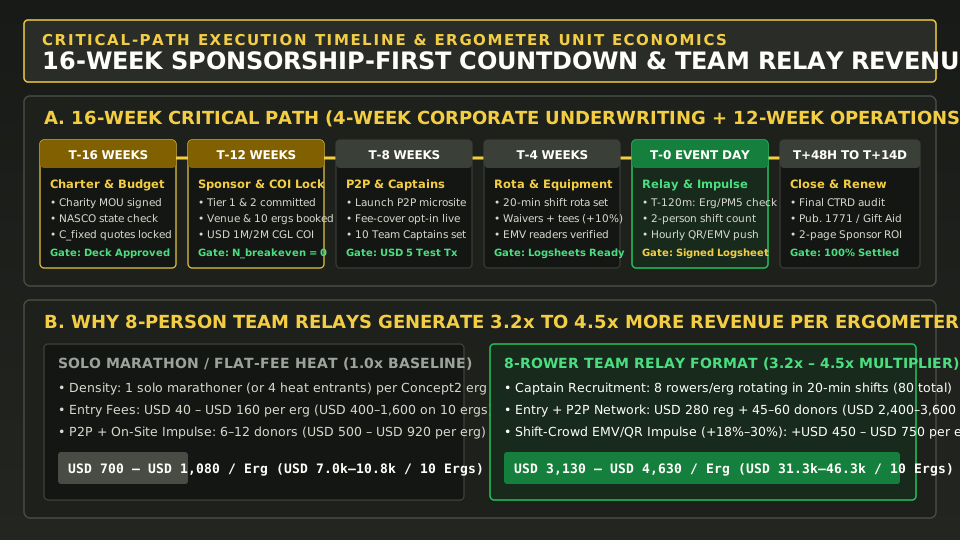
While our 12-week charity challenge plan fits informal events with near-zero fixed overhead, knowing how to host a charity event with USD 5,000–15,000+ in corporate sponsorships, a venue lease, and a USD 1M / USD 2M liability insurance certificate requires prepending a 4-week corporate underwriting window (T-16w to T-12w) so sponsor invoices clear before public P2P registration opens at T-8 weeks.
The 16-Week Sponsorship-First Critical Path (T-16w to T+48h)
| Milestone window | Critical-path deliverables | Owner | Hard Go / No-Go gate |
|---|---|---|---|
| T-16 Weeks — Charter & Budget Lock | Sign written beneficiary MOU (Step 1 money route); verify state solicitation registration (NASCO); lock C_fixed quotes; set target CTRD <= USD 0.20–0.28; finalize 4-tier sponsorship deck. |
Event Lead & Finance Lead | Signed charity MOU + itemized C_fixed quotes + approved sponsor deck. |
T-12 Weeks — Sponsor Lock, Venue & COI |
Pitch Tier 1 & Tier 2 sponsors to cover >= 100% of C_fixed; execute venue lease; reserve 8–12 Concept2 ergometers (challenge vs race setup); bind USD 1M/2M CGL + Participant Accident COI naming venue as Additional Insured. |
Finance Lead & Event Lead | R_sponsor >= 1.0 × C_fixed committed (N_breakeven = 0) + venue COI accepted. |
| T-8 Weeks — P2P Launch & Team Captains | Launch charity P2P microsite with Title/Gold logos (IRS Pub. 598 compliant); enable donor fee-coverage checkbox and UK Gift Aid postcode flow; recruit 8–12 Team Captains who each build a 6–10 person relay squad. |
Communications Lead & Captain | 100% of Team Captain lanes assigned + live USD 5 test gift settled. |
| T-4 Weeks — Shift Rota, Waivers & Readers | Collect signed waivers; convert distance (100,000 m or 1,000,000 m) into shifts via the rowing pace per 500m chart and relay handoff allowance model; order shirts/medals (+10% buffer); test EMV contactless readers. |
Participant Captain & Counting Lead | Published 20-min shift rota + printed counting sheets + reader Wi-Fi test. |
| T-0 (Event Day) — Counting & Impulse Giving | T-120m: Level ergs, check PM5 firmware, test projector and card readers. T-30m: Brief captains on two-person shift counting. Hourly: Announce meter/money totals and run QR/EMV tap-to-give match pushes during changeovers. | Counting Lead & Event Lead | Dual-initialed final logsheet + PM5 verification photos + terminal batch report. |
| T+48 Hours (to T+14d) — Receipts & ROI Deck | Reconcile gross P2P, EMV, and sponsor funds against C_total; compute final CTRD; issue IRS Pub. 1771 receipts (>= USD 250 and > USD 75 Quid Pro Quo) or HMRC Gift Aid schedule; send 2-page Sponsor ROI Impact Report for renewal. |
Finance Lead & Comms Lead | 100% net funds settled in charity account + tax receipts queued + ROI decks sent. |
Why Team Relay Formats Multiply Revenue per Ergometer by 3.2x to 4.5x
In an indoor endurance challenge, machine-hours and floor space are the bottleneck (8 to 12 Concept2 ergometers in a community gym). Choosing an 8-Person Team Relay format (6–10 participants/erg) over a Solo Marathon or Flat-Fee Heat format (1–4 solo entrants/erg) multiplies revenue per machine through four mechanisms:
- Captain-Led Decentralized Recruitment (
8xAthlete Density per Erg): Instead of marketing80individual tickets, the committee recruits 10 Team Captains (one per erg lane), and each captain recruits7teammates to rotate 20-minute shifts (see team relay vs solo pacing). - Peer-to-Peer (
P2P) Donor Networks vs Flat Entry Fees (USD 350–650vsUSD 40): Solo heat racers pay a flatUSD 40entry fee and rarely solicit donors. In a continuous100,000-meterteam relay (7 hours 46 minutes 40 secondsat2:20/500mper the Concept2 pace calculator), each rower taps6–9personal donors, generatingUSD 2,400–3,600in P2P gifts per ergometer. - Shift-Change Spectator Footfall & Day-Of Contactless Impulse Giving (
+18%–30%Lift): Rotating8teammates every20 minuteskeeps supporters around the changeover area, where EMV contactless card readers and QR codes addUSD 450–750per ergometer in impulse donations. - Corporate CSR Station Bundling (
+USD 1,000Gold Tier): An 8-person corporate relay squad naturally bundles into aUSD 1,000Tier 2 Gold Station Sponsorship.
| Unit-economics metric (8-hour window, 10 ergs) | Solo Marathon or Flat-Fee Heats (1–4/erg) |
8-Person Team Relay (8 rowers/erg) |
Venue revenue impact |
|---|---|---|---|
Participants per ergometer (10 ergs) |
1 solo (or 4 heat entrants = 10–40 total) |
8 relay teammates (80 rowers on 10 ergs) |
2.0x to 8.0x athlete density |
| Registration fee revenue per erg | USD 40 – USD 160 (USD 400–1,600 on 10 ergs) |
USD 280 (8 × USD 35 = USD 2,800 on 10 ergs) |
+USD 1,200 to +USD 2,400 entry base |
| P2P donor network per ergometer | 6–12 donors (USD 450 – USD 800 P2P/erg) |
45–60 donors (USD 2,400 – USD 3,600 P2P/erg) |
4.0x to 5.3x donor reach |
| Day-of EMV/QR impulse giving | USD 50 – USD 120 per erg |
USD 450 – USD 750 per erg |
+USD 4,000 to +USD 6,300 live lift |
| Total gross revenue per ergometer | USD 700 – USD 1,080 per erg (USD 7.0k–10.8k) |
USD 3,130 – USD 4,630 per erg (USD 31.3k–46.3k) |
3.2x to 4.5x multiplier per erg |
Takeaway: Prepend a 4-week corporate underwriting window (T-16w to T-12w) ahead of operations, and run 8-person team relays rather than solo heats to multiply gross revenue per ergometer by 3.2x to 4.5x.
4. Five High-Cost Financial & Compliance Failure Modes (and How to Prevent Them)
| Failure mode | Root cause | Financial or statutory consequence | Mandatory preventive control |
|---|---|---|---|
1. Uncovered Fixed-Cost Shortfall (N < N_breakeven) |
Signing binding venue or AV contracts at T-10w hoping ticket sales at T-4w will pay them. |
A 40% turnout drop pushes CTRD above 0.50, breaching BBB Standard 9 (<= 0.35). |
Enforce the T-12w gate: require written sponsor commitments (R_sponsor >= 1.0 × C_fixed) before signing leases. |
2. Accidental UBTI Advertising Trigger |
Printing promo codes, prices, or comparative slogans on banners, shirts, or PA scripts. | Strips IRC §513(i) QSP status (IRS Pub. 598), triggering 21% federal UBIT. |
Restrict sponsor creative to logos, URLs, and value-neutral product descriptions in the sponsor contract. |
3. Missing IRS Pub. 1771 Quid Pro Quo Notice (> USD 75) |
Selling a USD 85 VIP entry (USD 30 FMV meal/gear) without written FMV disclosure because net gift (USD 55) is < USD 75. |
IRC §6115 applies to gross payments > USD 75; non-disclosure incurs a USD 10/gift penalty up to USD 5,000 (IRC §6714). |
Auto-print good-faith FMV and Deductible = Gross - FMV on all gross checkout receipts > USD 75.00. |
| 4. Invalidated UK HMRC Gift Aid Claims | Claiming Gift Aid (+25%) on entry fees, corporate checks, or forms with work postcodes. |
HMRC audit claws back 25p/£1 reclaims plus interest. |
Enable Gift Aid strictly on voluntary individual P2P gifts with mandatory home house-number and UK postcode fields. |
| 5. Personal Account Routing & Deductibility Loss | Routing registration or reader payouts to a personal bank/Venmo account before forwarding to the charity. | Per FTC crowdfunding guidance, gifts to individuals are not tax-deductible. | Connect all P2P pages and on-site EMV readers directly to the charity’s merchant account. |
Takeaway: Audit every sponsor agreement against IRS Publication 598, every gross payment > USD 75 against IRS Publication 1771, and every checkout flow against FTC and HMRC rules before opening registration at T-8 weeks.
Related reading
Explore these companion guides in Event Planning and Endurance Challenges:
- How to Organize a Charity Event: A 12-Week Plan for Endurance Challenges — Donation routing options, six volunteer roles, and two-person shift meter counting sheets.
- Contactless Donations at Events: NFC, EMV and Chip Explained — Deploying EMV contactless readers alongside QR and NFC web tags for day-of impulse giving.
- Endurance Challenges: Team Relay Handoffs and Solo Pacing — Changeover time allowances and turn-record ownership across multi-person team relays.
- Indoor Rowing Challenge vs Race: Choose Your Event Format — Comparing cumulative logbook challenges, live ErgRace setups, and continuous team relays.
- Rowing Pace per 500m Chart: Split to Time and Distance — Converting
100,000 mor1,000,000 mrelay distances into venue booking hours. - Verify a Concept2 Rowing Result: Logbook, Rankings and Relay Evidence — Witness logsheets and PM5 verification codes for official record attempts.