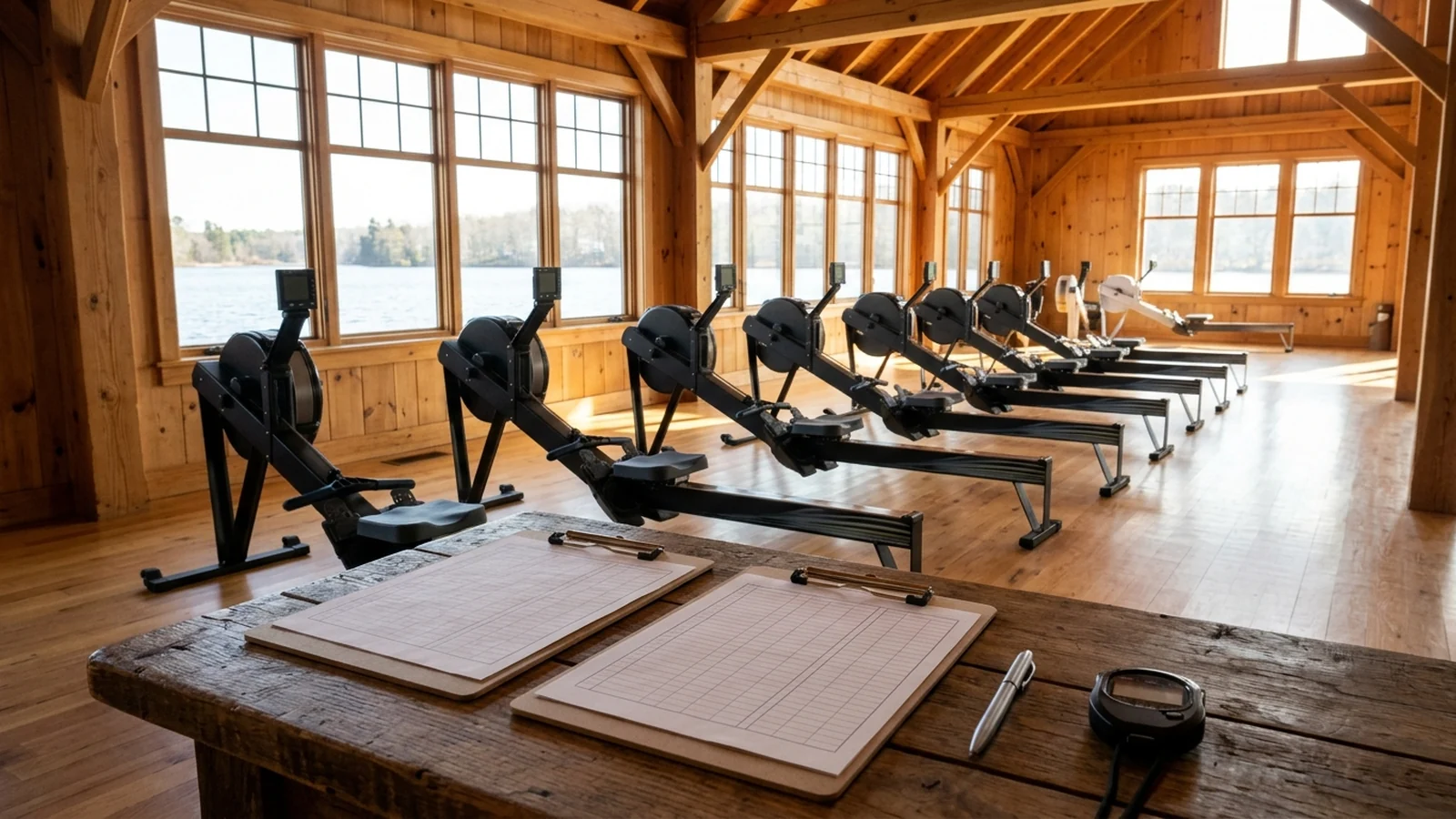
Organizing rowing fundraisers requires clear upfront rules separating individual distances, team relay totals, and per-meter or flat donor pledges before the first flywheel spins. Whether a club runs a 4-to-12-machine boathouse ergathon with 4 to 8 volunteers or a multi-shift endurance relay, volunteers must log start-and-end monitor deltas on un-reset machines so cumulative screen readings are never billed twice.
This guide covers meter-counting rules, split-to-distance goal sizing, relay shift reconciliation, and tax or Gift Aid sponsorship form columns for an indoor rowing fundraiser or charity row. This publication is an independent informational resource that does not represent any charity and does not collect donations. For venue overhead, break-even underwriting, and corporate sponsorship tiers, see our companion guide on how to organize a fundraiser event budget and sponsorship. For shift rotation cadence and physiological pacing, use our guide on endurance challenges team relay and solo pacing, or browse all event planning guides and the full editorial journal.
Choosing Rowing Fundraiser Formats by Meter-Counting Basis
Selecting between rowing fundraising ideas starts with deciding what unit of effort the pledge sheet records: an individual rower’s distance, a continuous relay score, a collective club total, an online logbook challenge, or a calendar grid.
- Youth crew cost drivers and gift-card rebates: RaiseRight states that youth rowing participation can exceed $1,000 per child annually before extra training, travel, and competition fees, describes an Ergathon as participants rowing on ergometers for a set amount of time or distance while collecting pledges or donations for every meter rowed, and reports that its gift-card and shopping program earns 6% average (up to 20%), with the highest-earning crew on RaiseRight earning $5,812 in 2025.
- Ergathon staffing and resource planning: SchoolFundraisers.com describes an Ergathon as pairing visible athletic effort with pledges tied to meters rowed, time on the erg, or a flat donation per athlete, and lists typical Ergathon resources as 4-12 machines depending on team size, 4-8 volunteers (registration, timers, safety, fulfillment), $200-$1,000 local business sponsorship tiers, an 8-week planning timeline, and 20-40% margins on pre-sale product fundraisers.
- Simultaneous versus turn-taking club ergathons: Mightycause defines an erg-a-thon as rowing teams raising money by rowing as long as possible on an indoor rowing machine (erg), either simultaneously or taking turns, and reports that the Chicago Rowing Union raised more than $9,000 during their 2016 Erg-a-Thon.
- Pick-a-date calendar alternative without meter logs: CalendarFundraiser’s rowing crew fundraiser template uses a 31-day pick-a-date calendar where 1× date pricing (Day 3 = $3, through Day 31 = $31) equals a $496 season budget per rower, and 3× date pricing (Day 3 = $9, Day 14 = $42, Day 31 = $93) equals $1,488 per rower at full claim or $59,520 across 40 rowers, with real team campaigns filling 60–85% of their dates.
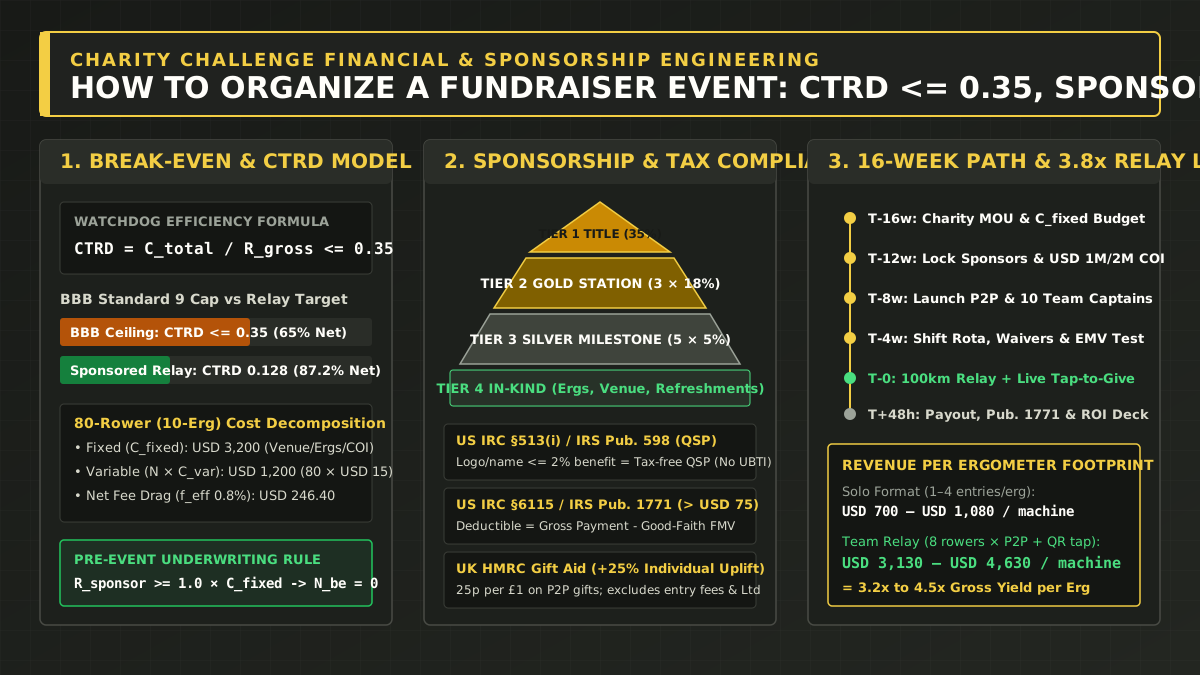
- Upstream relay efficiency benchmark: In our site’s fundraiser budget and sponsorship guide, BBB Wise Giving Alliance Standard 9 sets a maximum fundraising cost-to-raise-a-dollar (CTRD) cap of <= USD 0.35 (<= 35% of related contributions, preserving >= 65% net charitable yield), while community endurance relays target USD 0.15–0.28 and 6–10 rowers per erg generate 3.2x to 4.5x higher revenue per erg than solo heats (USD 3,130–4,630/erg).
Club, Collegiate, and Military Charity Row Benchmarks
Published club, collegiate, and military campaigns show how organizers structure individual and collective distance goals:
- Short single-erg community relay: Treasure Coast Rowing Club (TCRC) structures its 2027 TCRC Ergathon (9:00 AM–1:00 PM) around 10 club teams with a $40,000 total fundraising goal, plus a Community Relay Challenge where teams of up to 6 adults (ages 18+, suggested team goal $500+) share one Concept2 RowErg for 20 minutes (one person rowing at a time, switching as often as desired provided every registered member rows) and the total meters on the monitor at 20:00 become the team’s official score.
- Whole-club collective meter goal: Capital City Rowing (CCR), a 501(c)(3) non-profit, runs its annual Ergathon (2:00 setup, 3:00-5:00 rowing) with a collective team goal of 500,000 meters and a $25,000 fundraising goal (with individual raffle minimums of $500 for High School and $350 for Middle School), noting that shells (8+, 4+, 2x, 1x) cost $10k to over $42k, oars cost $500 to $750 each, coxswain boxes run approximately $1,200K, riggers/seats/shoes cost $50 to $500, and online processing fees are 2.9% + $.30 per transaction.
- Public venue scholarship and fleet ergathon: Sammamish Rowing Association (SRA) runs its Ergathon 2026 (10:00 a.m. to 1:00 p.m. at Redmond Town Center) with a $50,000 fundraising goal to fund scholarships (having awarded $70,000 in scholarships to more than 40 athletes in 2026) and fleet equipment (intermediate racing singles, a lightweight quad, new oars, and two new Hudson 8+ shells for 2027).
- Collegiate continuous ergathon with live sprint pledges: Washington University Rowing (WashU Crew) runs a 24-hour continuous Ergathon (12:00 PM to 12:00 PM) with a collective team goal of over 1,000,000 meters to fund travel to the Head of the Charles regatta, and sells live in-workout donor incentives: a $1 Power 10 (pulling the 10 hardest strokes, ~100m, in the middle of a workout) and a $5 Early Sprint (rowing 500m of hard strokes in the middle of a workout).
- Campus spring training fundraiser: Case Western Reserve University Rowing (Case Crew) runs an annual 24-hour continuous Ergathon where groups of rowers erg continuously in a public campus space, raising $10,000+ to fund the team’s March spring training trip to Melton Hill Lake in Oak Ridge, Tennessee.
- Memorial and solo endurance charity row: In Concept2’s profile of UCanRow2 lead Sarah Fuhrmann, she describes continuing coach Terry Smythe’s legacy through a ‘meters melanoma fundraiser’ with the Michigan Tech crew and personally finishing a 24 hour indoor row.
- Shipboard multi-erg log sheets and squadron row-a-thon: In Concept2’s Military Challenge during February, 2529 people participated representing 170 teams from 26 countries, and the crew of the USS Harry S. Truman (CVN75) accumulated 19,766,726 meters using 10 RowErgs with log sheets near the machines, including individual 50,000 meter sessions and a 24-hour Ripper Row-a-Thon by squadron VFA-11 covering almost 400,000 meters on two ergs.
| Organizer or Campaign | Published Format and Meter Scope | Fundraising Goal and Pledge Mechanism |
|---|---|---|
| Treasure Coast Rowing Club (TCRC) | 2027 TCRC Ergathon (9:00 AM–1:00 PM) across 10 Teams plus a 20 minutes single-RowErg Community Relay for up to 6 adults (ages 18+) where total meters on the monitor at 20:00 become the team score | $40,000 total club fundraising goal and $500+ suggested team goal for the 6 adults Community Relay |
| Capital City Rowing (CCR) | Annual 501(c)(3) Ergathon (2:00 setup, 3:00-5:00 rowing) with a collective team goal of 500,000 meters | $25,000 fundraising goal with $500 High School and $350 Middle School raffle minimums (shells 8+, 4+, 2x, 1x from $10k to over $42k, oars $500 to $750, coxswain boxes $1,200K, riggers/seats/shoes $50 to $500, online fee 2.9% + $.30) |
| Sammamish Rowing Association (SRA) | Ergathon 2026 from 10:00 a.m. to 1:00 p.m. at Redmond Town Center | $50,000 fundraising goal for fleet equipment (two new Hudson 8+ shells for 2027, intermediate racing singles, lightweight quad, new oars) and scholarships ($70,000 awarded to more than 40 athletes in 2026) |
| Washington University Rowing (WashU Crew) | 24 hours continuous Ergathon (12:00 PM to 12:00 PM) targeting over 1,000,000 meters | Regatta travel fundraising plus live $1 Power 10 (pulling the 10 hardest strokes, ~100m) and $5 Early Sprint (500m of hard strokes) donor incentives |
| Case Western Reserve University Rowing (Case Crew) | 24-hour continuous campus Ergathon by groups of rowers | $10,000+ raised for the March spring training trip to Melton Hill Lake in Oak Ridge, Tennessee |
| CalendarFundraiser crew template | 31-day pick-a-date calendar (Day 3 through Day 31) with no meter logging required | 1× date pricing (Day 3 = $3, Day 31 = $31) equals a $496 season budget per rower; 3× date pricing (Day 3 = $9, Day 14 = $42, Day 31 = $93) equals $1,488 per rower at full claim or $59,520 across 40 rowers (60–85% of dates filled) |
Multi-Day Online Logbook Challenges
Clubs that organize a multi-week virtual rowing fundraiser often align their pledge sheets with online logbook individual or team challenges:
- Holiday Challenge individual format and eligible machines: Concept2’s Holiday Challenge 2026 runs from November 26 to 11:59 p.m. December 24 with goals of 100,000 meters or 200,000 meters on Concept2 RowErg, SkiErg, and BikeErg only (no on-water/on-snow meters), and is strictly an individual challenge where teams are not used.
- Kids and adaptive Holiday Challenge tiers: In the Concept2 Holiday Challenge, the Kids’ Holiday Challenge allows kids aged 16 and under to participate at 50,000 meters, adaptive athletes can choose the 50k, 100k, or 200k levels, and the deadline for entering meters is 11:59 pm GMT (6:59 pm ET), January 4th.
- Per-kilometer corporate matching rates: For every person who rows, skis, or rides 100k during the Concept2 Holiday Challenge, Concept2 donates $.02 per kilometer (1000 meters) to the participant’s chosen charity and $.04 per additional kilometer beyond 100k (with the $.04 rate taking effect at 50k for kids and adaptive participants).
- Logbook charity selection and pin rule: Concept2 Holiday Challenge participants must choose a charity from the main Logbook page (or select ‘Let Concept2 Choose’ or ‘Do Not Donate’); people who do not make any selection are not eligible for a Holiday Challenge pin if they reach 200,000m.
- Direct routing for personal donations: For participants interested in making an additional personal donation to the Concept2 Holiday Challenge charities, Concept2 asks that they send their donations directly to the charities via each charity’s site.
- 32-day window and per-kilometer rates: Concept2’s 24th Annual Holiday Challenge ran from November 23 to December 24 (32 days total), where rowing, skiing, or riding 100k on the RowErg, SkiErg, or BikeErg triggered a $.02 per kilometer (1000 meters) donation and $.04 per additional kilometer beyond 100k, with BikeErg meters counted as half.
- 24th annual Holiday Challenge participation and charity payouts: In the 24th annual Concept2 Holiday Challenge (2023), 21,681 people from 95 countries logged 5,755,067,909 meters between American Thanksgiving and Christmas, reaching Concept2’s goal of raising $70,000 for five not-for-profit organizations ($6821.61 World Resources Institute, $17,762.46 Charity: Water, $13,943.61 World Central Kitchen, $24,557.48 Save The Children, and $6,914.84 VT Community Foundation Flood Relief).
- Affiliation versus seasonal Team Challenges: Concept2 Online Logbook Help distinguishes an Affiliation (a year-round group of rowers showing meter totals on Affiliation Standings) from a Team, which is established on the Teams page specifically for the three annual team challenges: Virtual Team Challenge (Jan 1–Jan 31), World Erg Challenge (Mar 15–Apr 15), and Fall Team Challenge (Sept 15–Oct 15).
- Virtual Team Challenge window and deadlines: Concept2’s Virtual Team Challenge (VTC) runs from 12:00 a.m. January 1 to 11:59 p.m. January 31 for teams of at least two (2) people on RowErg, SkiErg, and BikeErg (BikeErg meters counted as half), with a team enrollment deadline of January 16 23:59 GMT (18:59 ET) and a meter entry deadline of February 3 23:59 GMT (18:59 ET).
- World Erg Challenge window and deadlines: Concept2’s World Erg Challenge runs from 12:00 a.m. March 15 to 11:59 p.m. April 15 for teams of at least two (2) people on RowErg, SkiErg, and BikeErg (BikeErg meters counted as half), with a team enrollment deadline of March 30 23:59 GMT (19:59 ET) and a meter entry deadline of April 18 23:59 GMT (19:59 ET).
- Fall Team Challenge window and deadlines: Concept2’s Fall Team Challenge (FTC) runs from 12:00 a.m. September 15 to 11:59 p.m. October 15 for teams of at least two (2) people on RowErg, SkiErg, and BikeErg (BikeErg meters counted as half), with a team enrollment deadline of September 30 23:59 GMT (19:59 ET), a meter entry deadline of October 18 23:59 GMT (19:59 ET), and completion rewards at 100k or 200k.
Sizing Meter Goals with Split-to-Time Pacing Math
Before printing a target distance on a pledge sheet, organizers check whether the promised meters match the crew’s split pace, active ergometer count, and changeover time. A wider operational timeline for event logistics is covered in our charity challenge event planning guide.
Pacing Formulas and Worked Relay Calculations
Use published ergometer pace equations and relay handoff allowances to verify your target distance before donors sign per-meter pledges:
- Erg Pace Calculator equations: Concept2’s Erg Pace Calculator relates distance (meters), 500m split (seconds), cumulative time (seconds), and average watts using
distance = (time/split) * 500,split = 500 * (time/distance),time = split * (distance/500), andwatts = 2.8/(split/500)³. - Two-thousand-meter worked split check: In Concept2’s Erg Pace Calculator worked example, entering a distance of 2000 meters and a 500m split of 1:50 returns a cumulative time of 7:20.
- Worked 100,000-meter relay shift schedule: At an average split of 2:20 for each 500 m (140 seconds), a 100,000 m indoor rowing relay requires
140 × 100,000 ÷ 500 = 28,000seconds of rowing (7 hours 46 minutes 40 seconds), which in 20-minute shifts covers about 4,286 m per shift across 23 full shifts plus a final shift of 6 minutes 40 seconds for eight rowers. - Relay changeover time allowance: In a continuous team relay, budgeted elapsed time is modeled as
estimated moving time + number of handoffs × allowance per handoff, illustrated for six turns and five 20-second exchanges as50 min + 5 × 20 s = 51 min 40 s.
Official Individual and Team Record Configurations
When a charity row also aims for a ranked workout entry or an official indoor rowing record, the monitor setup and team composition follow published requirements:
- Rankable Online Logbook distances and durations: In the Concept2 Online Logbook, rankable single-distance and timed workouts for the RowErg and SkiErg are 100 Meters, 500 Meters, 1000 Meters, 2000 Meters, 5000 Meters, 6000 Meters, 10000 Meters, 21,097 Meters (half marathon), 42,195 Meters (marathon), 100,000 Meters (team event), 1 minute, 4 minutes, 30 minutes, and 60 minutes.
- Individual record piece and verification code rules: Concept2 Individual Record Requirements state that all individual records must be single distance or timed pieces (no interval pieces) started from a non-moving flywheel, and note that a photo of the PM screen is not an acceptable form of verification unless the verification code is displayed on the screen as well.
- Individual ultra-distance rest and monitor sleep rules: For Concept2 individual ultra-distance records, the monitor automatically shuts down after a couple of minutes of inactivity unless someone presses Display or Change Display; in an individual 24 Hour Row/Ski the athlete must row or ski within each hour of the 24 hours, and in an individual Longest Continual Row/Ski the athlete must row at least 50 minutes of every hour (permitted up to 10 minutes of rest per hour).
- Lightweight and heavyweight class thresholds: Concept2 weight requirements for RowErg records define Lightweight Women as <= 135lbs (61.5kg), Heavyweight Women as > 135 lbs (61.6kg), Lightweight Men as <= 165lbs (75kg), and Heavyweight Men as > 165lbs (75kg), weighed in no earlier than two hours before their race.
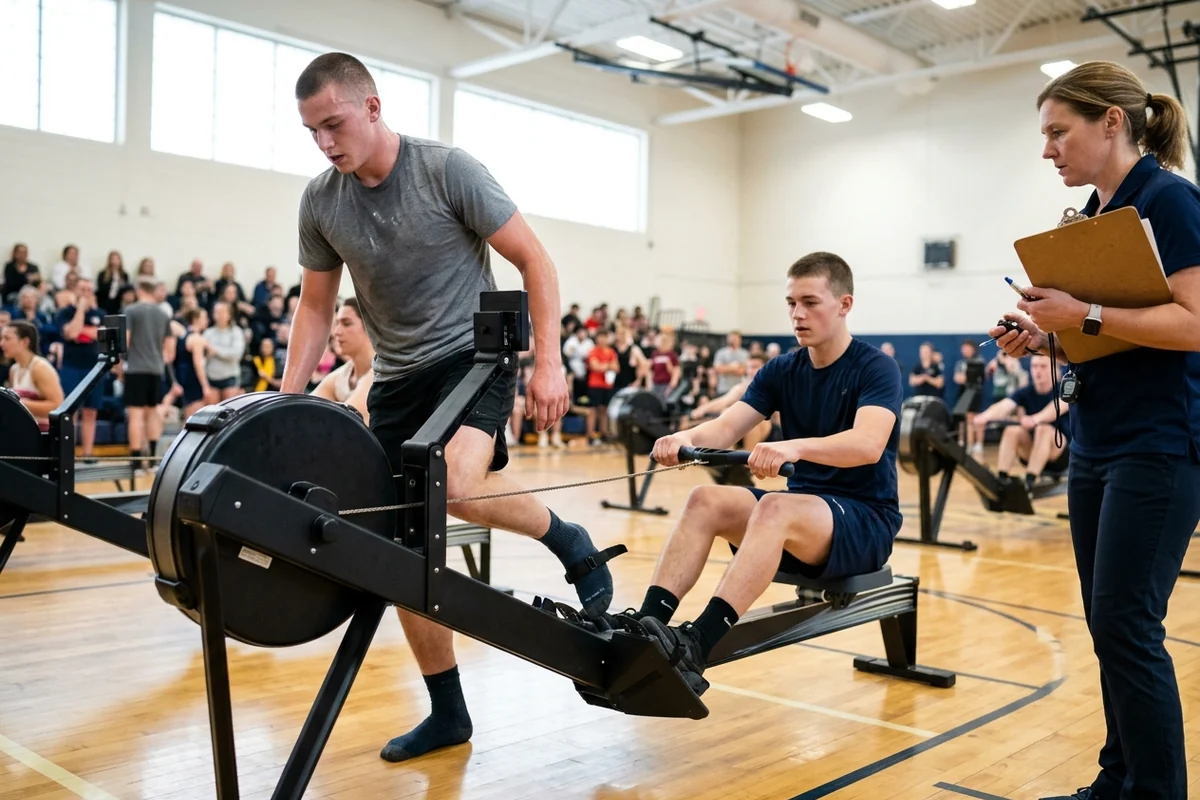
- Single-erg team relay flywheel and witness log rules: Concept2 Team Record Requirements specify using a single Concept2 RowErg or SkiErg with a Performance Monitor (PM5, PM4 or PM3) where the flywheel cannot stop spinning until the attempt is complete, and require a witness-signed logsheet of who rowed, when they rowed, and what the Performance Monitor read (meters/time) when they started and ended their session, including age and weight class.
- Tandem two-person participation share: Concept2 Team Record Requirements state that Tandem (2-person) attempts must have both rowers rowing at least 40% or more of the time for the 24 Hour Row and Longest Continual Row and 40% or more of the total meters for a 100,000 Meter Row or Million Meter Row.
- Team size categories and mixed-gender rule: Concept2 Team Record Requirements recognize three team size categories—Tandem (2 people), Small team (3–10 people), and Large team (over 10 people)—and require mixed teams to have at least 1/3 men and 1/3 women, with both the collective men and collective women each rowing at least 1/3 of the time or 1/3 of the distance (for example, a small team of 10 must have at least 4 women).
- Ultra-distance team monitor programming: For Concept2 ultra-distance team records, a 100,000 Meter Row/Ski uses a single distance interval of 100,000 meters with 0:00 rest, a 24 Hour Row/Ski uses a single time interval of 24 hours with 0:00 rest, a Million Meter Row/Ski uses one distance interval of 900,000 meters and one distance interval of 100,000 meters with 0:00 rest, and a Longest Continual Row/Ski uses Just Row/Just Ski (counting up to 50,000 before flipping back to 0).
- High School 4-Erg Million Meter Row in ErgRace SUM mode: Concept2’s High School 4-Erg Million Meter Row requires students in grades 9–12 from the same school using four indoor rowers (PM3, PM4 or PM5) with ErgRace software set to a Team Race distance of 1,000,000 meters with the setting changed from ‘Average’ to ‘SUM’ across 4 boats, recording the final time when the sum of all RowErgs has gone the entire million meters.
Double-Counting Failure Modes on Relay and Challenge Logs
Accounting errors in rowing fundraisers happen when organizers combine individual and team distances or copy unadjusted monitor numbers onto pledge sheets.

Mixing Individual Meters and Team Meters on One Pledge Sheet
Separating individual workouts from collective team totals on the pledge sheet prevents confusion over which distance a per-meter pledge sponsors:
- Individual-only challenge structure: Because events like the Concept2 Holiday Challenge (November 26 through December 24 at 100k or 200k indoor meters) credit solo athletes only with no team roster aggregation, per-meter pledges tied to that logbook must index to one athlete’s verified workout total.
- Multi-erg team sum configuration: Conversely, multi-boat events such as the High School 4-Erg Million Meter Row configure ErgRace in
SUMmode rather thanAverageacross four linked RowErgs so sponsors backing the collective 1,000,000-meter target know their rate applies to combined four-erg output.
Summing Un-Reset Performance Monitor Readings Across Relay Shifts
On a shared relay machine where the monitor is not reset between rotations, the displayed distance at the end of each shift includes earlier shifts:
- Shift subtraction rule: On a multi-shift relay ergometer where the monitor is not reset between shifts (for example, M1 shift 1 rower A from 0 to 4,280 = 4,280 shift metres, and M1 shift 2 rower B from 4,280 to 8,510 = 4,230 shift metres), shift metres are always end reading minus start reading, and adding up the monitor readings themselves counts the same metres twice.
Adding Raw BikeErg or StrengthErg Meters Without Modality Weighting
In mixed-modality challenges, copying raw monitor numbers into a single column inflates total distance because different ergometers accumulate units at different rates. See our Skeleton Crew mixed-erg counting worksheet for a line-by-line daily layout:
- Holiday Challenge BikeErg and StrengthErg weighting: In the Concept2 Holiday Challenge, BikeErg meters are counted as half when applied to the challenge (a BikeErg workout of 40,000m gives 20,000m toward the challenge score), and on the StrengthErg every 5 Kg-m of work is worth 1 meter toward the challenge total (a StrengthErg workout with 25,000 Kg-m of work gives 5,000m).
- Team and individual challenge BikeErg half-count: Concept2 Online Logbook Help states that because BikeErg meters are accumulated at twice the rate as the RowErg or SkiErg, BikeErg meters are counted as half when applied to most individual and team challenges.
- Raw versus effective meter column separation: In our site’s Skeleton Crew worksheet, because BikeErg meters count as half while RowErg and SkiErg meters count in full, adding each monitor total in full produces the wrong sum (for example, 9,200 RowErg + 7,400 SkiErg + 16,800 BikeErg = 33,400 raw meters vs 9,200 + 7,400 + 8,400 = 25,000 effective meters), so raw meters and effective meters must be written on separate lines.
- On-water exclusions and separate Million Meter Clubs: Concept2 Online Logbook Help states that on-water, on-snow, and rollerski meters do not count toward Million Meter Club totals (though they are included in Annual Meters Honor Board totals), and RowErg meters count toward the RowErg Million Meter Club, which is separate from the SkiErg and BikeErg Million Meter Clubs.
- Million Meter Club recognition rules: Concept2’s Million Meter Club recognizes athletes who count up to one million meters (or more) in the free Concept2 Online Logbook with certificates and prizes, maintaining separate Million Meter Clubs for the RowErg, SkiErg, and BikeErg where meters cannot be combined.
Sharing One Logbook Profile or Duplicating Managed Account Entries
In multi-day virtual team challenges, account sharing or duplicate captain entries corrupt the team total. If logged workouts fail to appear on a challenge board, follow our challenge meters missing diagnostic order instead of re-entering the workout:
- One person per Concept2 Online Logbook account: Concept2 Online Logbook Help states that more than one person cannot use the same logbook (‘No, each person must have their own logbook account’), although multiple people can use the same email address if each person has a unique username.
- Personal profiles versus captain Managed Accounts: In Concept2 Online Logbook team challenges, each member has roughly 16 days to sign up, a team needs at least two active members to appear on the Standings, and members who have their own online profiles enter their own meters in their profiles (which are reflected in the team’s total), whereas Managed Accounts are created by a team captain only for team members who don’t have their own Logbook.
| Logging Scenario | What Fails When Copied Directly | Required Reconciliation Rule |
|---|---|---|
| Un-reset multi-shift relay ergometer (M1) | Adding up the monitor readings themselves counts the same metres twice | Subtract start reading from end reading (M1 shift 1 rower A from 0 to 4,280 = 4,280 shift metres; shift 2 rower B from 4,280 to 8,510 = 4,230 shift metres) |
| Mixed-erg worksheet with RowErg, SkiErg, and BikeErg | Adding each monitor total in full produces 9,200 RowErg + 7,400 SkiErg + 16,800 BikeErg = 33,400 raw meters | Write raw meters and effective meters on separate lines with BikeErg counted as half (9,200 + 7,400 + 8,400 = 25,000 effective meters) |
| Holiday Challenge with BikeErg and StrengthErg workouts | Counting BikeErg meters in full or StrengthErg Kg-m work without conversion | Count BikeErg meters as half (40,000m BikeErg workout gives 20,000m) and StrengthErg work at 5 Kg-m = 1 meter (25,000 Kg-m gives 5,000m) |
| Concept2 Online Logbook team challenge entries | More than one person using the same Concept2 Online Logbook account | Members without Managed Accounts enter their own meters in their online profiles (reflected in the team total); each member has roughly 16 days to sign up and a team needs at least two active members |
Pledge Sheet Columns and US IRS / UK HMRC Gift Aid Recordkeeping
A structured pledge sheet separates the athletic meter log from the donor financial ledger while capturing every field required for US federal tax acknowledgments or UK HMRC Gift Aid claims.

Core Meter Basis and Pledge Ceiling Columns
Before collecting donor signatures, set up two distinct column groups on the pledge form:
- Header Goal Declaration: Print both the individual rower’s target distance and the team’s collective target distance at the top of the sheet so sponsors see the scale difference before choosing a per-distance rate.
- Pledge Basis and Ceiling Columns: Require every sponsor row to mark a single basis—Individual Rower Meters Only, Team Cumulative Meters, or Flat Donation—paired with a Pledge Ceiling column so a per-meter rate never bills more than the sponsor authorized.
US IRS Substantiation and Quid Pro Quo Disclosure Fields
When a US charitable organization collects rowing fundraiser pledges, the pledge sheet and follow-up receipts follow federal tax substantiation and disclosure rules:
- Recordkeeping for all monetary contributions: Under IRS Publication 1771 and Internal Revenue Code Section 170(f)(17), a donor cannot claim a federal income tax deduction for any monetary contribution unless the donor maintains a record of the contribution or a timely written communication from the charitable organization showing the name of the organization, the date of the contribution, and the amount of the contribution.
- Contemporaneous written acknowledgment for $250 or more: Under IRS Publication 1771 and IRC Section 170(f)(8), a donor cannot claim a federal income tax deduction for any single contribution valued at $250 or more without a contemporaneous written acknowledgment from the donee charitable organization; separate contributions of less than $250 are not aggregated, and charities typically send acknowledgments no later than January 31 of the year following the donation.
- Insubstantial token exception thresholds: Under IRS Publication 1771 and Code Section 513(h)(2), goods or services given to a donor in a fundraising campaign are treated as insubstantial under the token exception if their fair market value does not exceed the lesser of 2 percent of the donor’s payment or $125, or if the donor’s payment is at least $62.50 and the charity provides only logo-bearing items costing $12.50 or less in the aggregate (2023 guideline amounts).
- Quid pro quo written disclosure above $75: Under IRS Publication 1771 (Rev. 11-2023) and IRC Sections 6115 and 6714, a charitable organization must provide a written disclosure statement to a donor who makes a quid pro quo payment exceeding $75 partly as a contribution and partly for goods and services; failure to meet the written disclosure requirement carries a penalty of $10 per contribution, not to exceed $5,000 per fundraising event or mailing.
UK HMRC Gift Aid Sponsorship Form Requirements
When a UK tax-recognised charity or community amateur sports club uses a sponsorship form for a charity row, the form must incorporate HMRC’s declaration and audit columns:
- Gift Aid reclaim rate and UK tax requirement: Under UK HM Revenue & Customs (GOV.UK) Gift Aid rules, a tax-recognised charity or community amateur sports club (CASC) can claim back 25p every time an individual donates £1, provided the donor has paid at least as much in Income Tax or Capital Gains Tax in that tax year and makes a Gift Aid declaration (with a separate small donations scheme for cash donations of £30 or less).
- Non-eligible payments and registration fees: Under UK HMRC Gift Aid rules, charities and CASCs cannot claim Gift Aid on payments for goods and services, donations of money from a company, a ‘minimum donation’ where there is no choice about payment, tickets to an event, or a deposit or registration fee that participants pay in advance of a sponsored challenge.
- Connected persons rule for sponsored challenges: Under UK HMRC Gift Aid rules for sponsored challenges, sponsorship payments from a ‘connected person’ (a wife, husband, civil partner, brother, sister, parent, grandchild, spouse/civil partner of a relative, or company under their control) only qualify for Gift Aid if the participant pays the full cost of the trip (such as flights and accommodation) themselves, and charities should include an explanation on the sponsorship form.
- Donor benefit value limits: Under UK HMRC Gift Aid benefit limits, a donation only qualifies for Gift Aid if the retail value of any benefit given to the donor does not exceed 25% of the donation for donations up to £100, or 25% of £100 plus 5% of £101 up to a maximum total benefit value of £2,500.
- Mandatory Gift Aid declaration elements: Under UK HMRC Gift Aid declaration rules, every Gift Aid declaration must include the name of the charity or CASC, the donor’s full name, the donor’s home address, whether the declaration covers past, present, or future donations or just a single donation, a statement (such as a tick box) that the donor wants Gift Aid to apply, and an explanation that the donor must pay at least as much UK Income Tax and/or Capital Gains Tax in a tax year as all charities and CASCs will claim on their gifts.
- Sponsored-event collection columns and 6-year retention: Under UK HMRC Gift Aid declaration rules, sponsored event sponsorship forms that include a Gift Aid declaration must also include the amount of donations collected, the date that pledged donations were collected, and the date when the sums collected were handed over to the charity, and charities/CASCs must keep declaration records for 6 years from the end of the accounting period they relate to.
| Jurisdiction and Rule | Threshold or Reclaim Rate | Required Pledge Sheet or Receipt Fields |
|---|---|---|
| US IRS Publication 1771, Section 170(f)(17) | Any monetary contribution | Record or timely written communication showing the name of the organization, the date of the contribution, and the amount of the contribution |
| US IRS Publication 1771, Section 170(f)(8) | Any single contribution valued at $250 or more (separate contributions of less than $250 are not aggregated) | Contemporaneous written acknowledgment from the donee charitable organization (typically sent no later than January 31 of the year following the donation) |
| US IRS Publication 1771, Code Section 513(h)(2) | Token exception (2023 guideline amounts): fair market value does not exceed the lesser of 2 percent of payment or $125, or payment is at least $62.50 with logo-bearing items costing $12.50 or less | Goods or services treated as insubstantial under the token exception |
| US IRS Publication 1771 (Rev. 11-2023), Sections 6115 and 6714 | Quid pro quo payment exceeding $75 partly as a contribution and partly for goods and services | Written disclosure statement required ($10 penalty per contribution, not to exceed $5,000 per fundraising event or mailing) |
| UK HM Revenue & Customs (GOV.UK) Gift Aid overview | 25p claimed back every time an individual donates £1 (separate small donations scheme for cash donations of £30 or less) | Donor must have paid at least as much in Income Tax or Capital Gains Tax in that tax year and make a Gift Aid declaration to the charity or CASC |
| UK HMRC Gift Aid donor benefit limits | Retail value of benefit does not exceed 25% of the donation for donations up to £100, or 25% of £100 plus 5% of £101 up to a maximum total benefit value of £2,500 | Verify any donor benefit stays within HMRC retail value limits |
| UK HMRC Gift Aid sponsored event sponsorship form rules | Declaration records kept for 6 years from the end of the accounting period they relate to | Sponsorship forms with a Gift Aid declaration must include amount of donations collected, date pledged donations were collected, and date sums collected were handed over to the charity or CASCs |
Target Meter Goal and Pledge Basis Checklist
Before printing your pledge sheets or opening participant signups, lock in your target meter goal and pledge basis across these operational inputs:
- Meter-counting basis: Will your pledge sheet index per-distance pledges strictly to each individual rower’s verified distance, to the crew’s cumulative relay total, or to a flat donation amount?
- Ergometer mix and shift logging rule: Which ergometer modalities are used, and if rowers share a relay machine without resetting the monitor, does your shift log sheet contain separate start reading, end reading, and shift meter subtraction columns?
- Pledge ceiling and tax receipt fields: Does every per-meter row include a donor-authorized pledge ceiling alongside the required US IRS or UK HMRC Gift Aid collection and handover date columns?
Sources
- Concept Indoor Rower — Erg Pace Calculator and Online Logbook Challenge Rules
- Concept Indoor Rower — Individual and Team Record Requirements
- Concept Indoor Rower — Holiday Challenge, Virtual Team Challenge, World Erg Challenge, and Fall Team Challenge Documentation
- Concept Indoor Rower — Military Challenge, Million Meter Club, and Athlete Profiles
- Internal Revenue Service — Charitable Contributions Substantiation and Disclosure Requirements
- HM Revenue & Customs (GOV.UK) — Claiming Gift Aid and Sponsorship Form Guidance
- CalendarFundraiser, SchoolFundraisers, RaiseRight, and Mightycause — Rowing Crew Fundraising Guides
- Treasure Coast Rowing Club, Capital City Rowing, and Sammamish Rowing Association — Club Ergathon Guides
- Washington University Rowing and Case Western Reserve University Rowing — Collegiate Ergathon Guides
- Thanks a Million Challenge — Charity Event, Fundraiser Budget, Team Relay Pacing, and Mixed-Erg Counting Guides