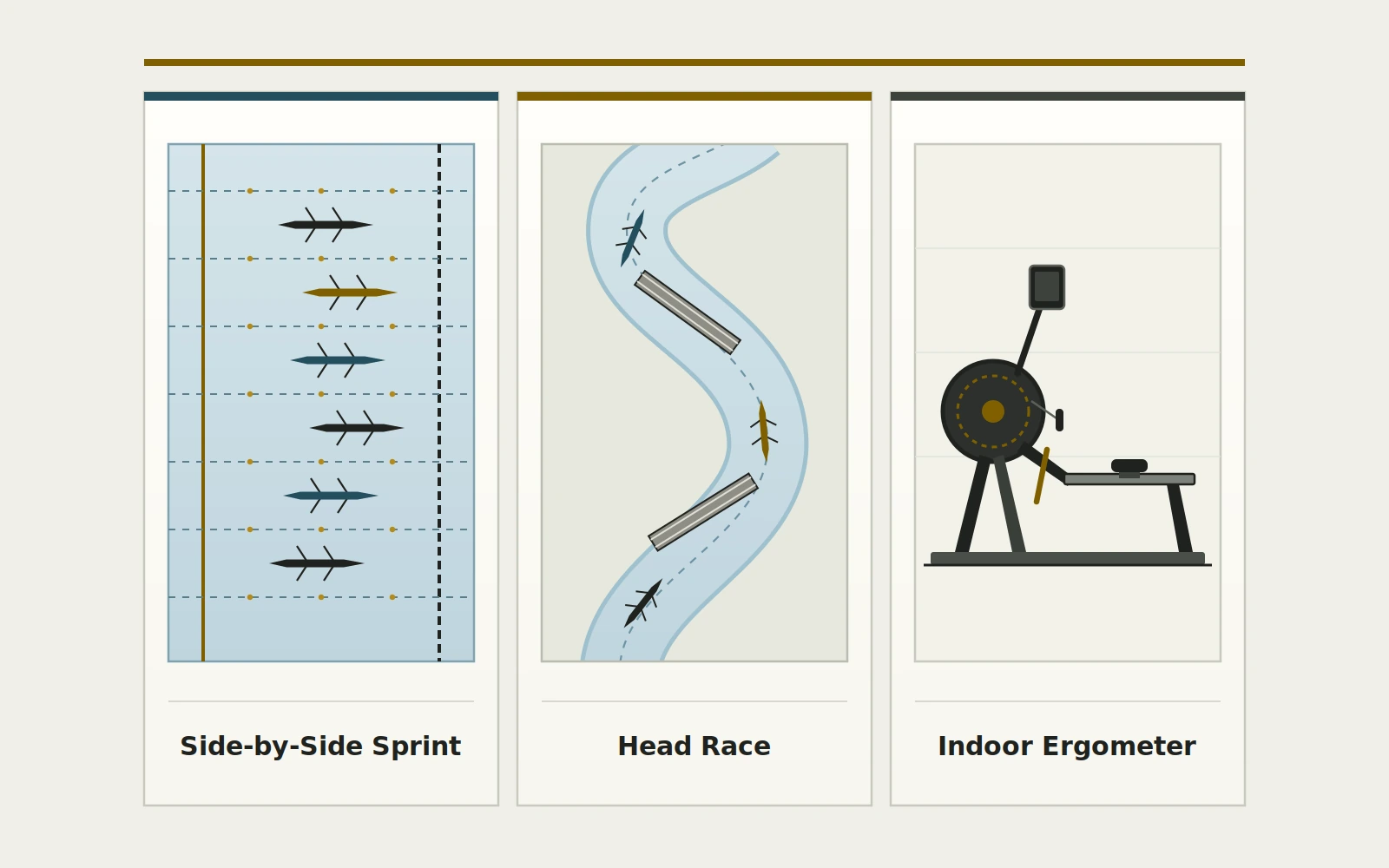
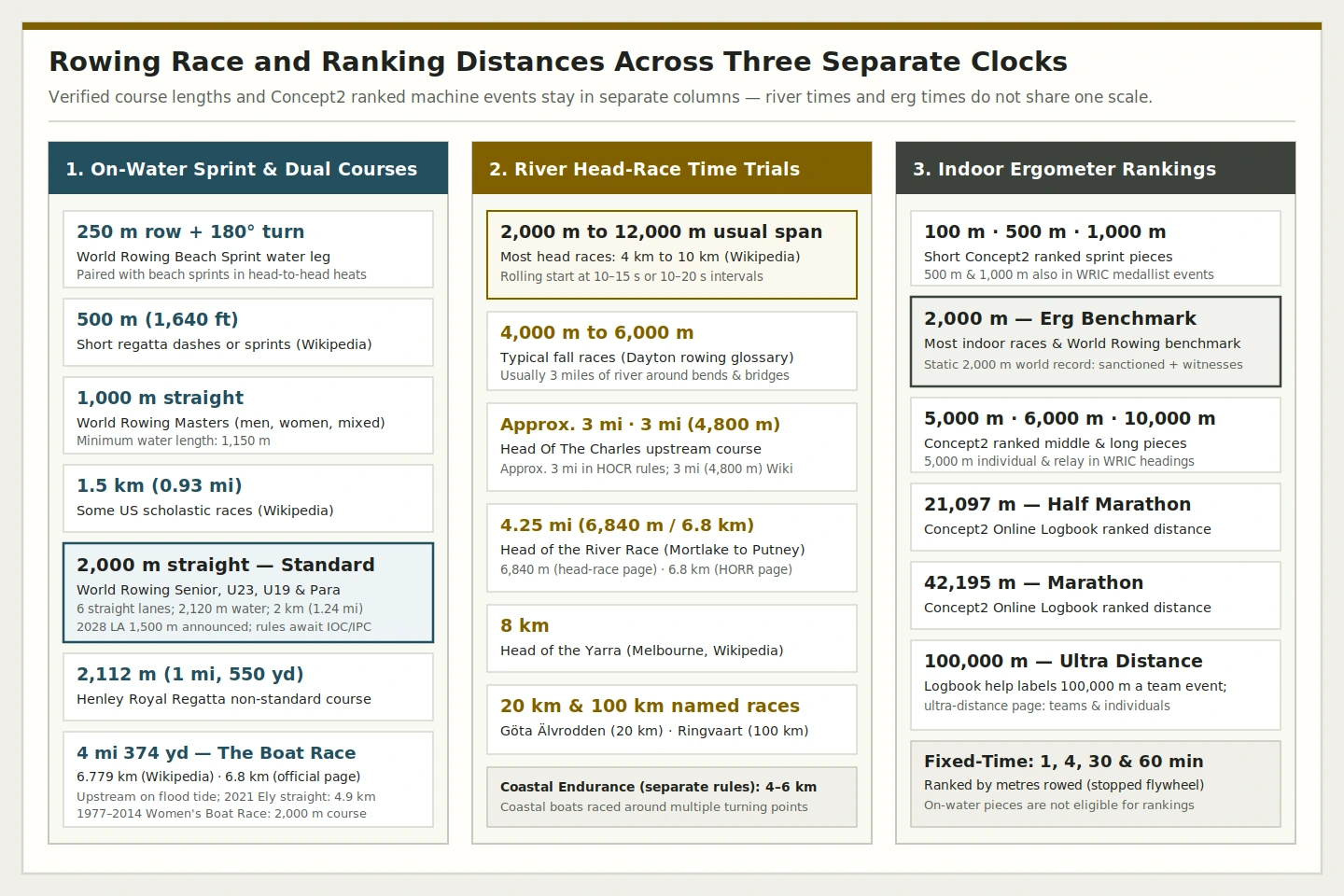
A standard international side-by-side regatta runs 2,000 metres on a straight multi-lane course, a river head race is a time trial over a longer course that need not be straight, and an indoor ergometer competition ranks either a fixed distance by finish order or a fixed time by distance rowed. World Rowing’s Overall and Classic Rowing rules, marked Last updated: July 1, 2025 and indexed as the 2026 World Rowing Rules of Racing - Overall & Classic Rowing, set 2,000 metres straight for Senior, Under 23, Under 19, and Para Rowing, while Masters crews race 1,000 metres straight. Indoors, both World Rowing and Concept2 center racing on 2,000 metres, alongside ranked sprints, marathons, and timed pieces.
Those three clocks are not interchangeable. River head races and traditional dual courses carry tide, current, wind, bridges, and river bends into every finish time. Concept2 logbook help excludes on-water pieces from its Rankings, and Wikipedia notes that physiological and performance tests on a rowing ergometer are not good indicators of on-water performance. Readers comparing multi-day logbook totals with single-start events can check our indoor rowing challenge versus race guide, or browse the wider indoor rowing guides and all rowing articles.
What is the standard Olympic rowing race distance?
The standard international and World Championship racing distance is 2,000 metres straight—written on Wikipedia as 2 kilometres (1.24 mi)—with a 1,500-metre course announced for Los Angeles 2028 pending final IOC and IPC programme updates in the rulebook. World Rowing’s classic rules define the standard international course as six crews racing in separate, straight, parallel lanes over 2,000 metres, and set 2,000 metres straight for men and women in Senior, Under 23, Under 19, and Para Rowing. World Rowing’s para rowing events page notes that starting in 2017, the Para race distance changed from 1,000 m to 2,000 m for all events.
Olympic course lengths evolved before settling on 2,000 metres for both men and women:
- Before 1912 Olympic courses: Wikipedia’s Olympic rowing history records Paris 1900 at 1,750 m, St. Louis 1904 at 3,218 m, and London 1908 at 2,414 m.
- Men’s Olympic races from 1912 to 2024: All men’s Olympic races from 1912 to 2024 took place over a 2,000 m course, except London 1948, which used an 1,850 m course.
- Women’s Olympic races: Women’s Olympic events ran over 1,000 m until 1988, when they changed to 2,000 m.
- Los Angeles 2028 announcement and rulebook status: Wikipedia reports that in 2024 World Rowing announced that rowing at the 2028 Olympics will take place over 1,500 meters because of limitations of the Long Beach Marine Stadium, which would be the shortest course used for men’s Olympic rowing. Alongside that announcement, World Rowing’s Overall and Classic Rowing rules file marked Last updated: July 1, 2025 retains 2,000 metres straight as the standard international racing distance, and its programme bye-law states that the events on the rowing programme for the 2028 Los Angeles Olympic Games and the 2028 Los Angeles Paralympic Games will be updated after final confirmation by the IOC and IPC.
World Rowing’s classic rulebook also separates water-basin geometry and weather or time-trial contingencies from the standard race length itself. Under World Rowing’s lane rule, races are held using up to six lanes, though in principle the course shall have at least eight. Under World Rowing’s course bye-laws, the minimum length of water necessary to contain the standard international course is 2,120 m, and for a Masters course the minimum water length is 1,150 m. Where conditions are so adverse that no other alternative is possible, World Rowing’s adverse-conditions rules allow reducing the length of a race to no less than 1,000 metres. When time trials run on a World Rowing standard course, the fixed-start distance is 2,000 m, and where a flying start is used, the racing distance should not be less than 1,900 metres.
How long is a rowing race in minutes?
A standard rowing race is defined by fixed distance—such as 2,000 metres straight—rather than a fixed number of minutes, so elapsed clock time is the competitive result rather than the rule. Only fixed-time indoor ergometer events lock the clock in minutes—such as 1 minute, 4 minutes, 30 minutes, or 60 minutes in Concept2’s rankings—and rank competitors by the distance rowed before time expires.
On open water, wind, river flow, tide, and course geometry move the finish clock from venue to venue and from year to year, which is why published river figures always attach to a named course, landmark, or cutoff rule:
- Full-course historical result in bad weather: On London’s Championship Course from Putney to Mortlake, Wikipedia records that in the 1877 Boat Race both crews finished in 24 minutes and 8 seconds in bad weather, and the race was declared a dead heat.
- Tidal assistance and intermediate landmark splits: The Boat Race official course page explains that The Boat Race is rowed upstream and timed to start on the incoming flood tide. On that same official course page, the 6 mins 20 secs men’s mark (set by Cambridge in 1998) and the 7 mins 8 secs women’s mark (set by Cambridge in 2017) are intermediate records to Hammersmith Bridge, not full-course times to Mortlake.
- Relative event-division cutoff gap: In the Head Of The Charles rules, any boat whose time is more than 10 minutes slower than the fastest time in its event-division may be recorded as DNF—a relative margin behind the division leader rather than a winning time.
For indoor ergometer pacing math across ranked machine distances, see our guide on what is a good rowing pace per 500m by distance.
How do spring regatta courses differ from fall head races?
Spring regattas use side-by-side lanes over a straight 2,000-metre course (or shorter sprint and Masters distances), whereas fall head races start boats single-file at timed intervals over longer, winding river courses. Wikipedia identifies side-by-side races and head races as the two most common regatta formats.
In side-by-side racing, crews start together and race in parallel lanes toward a shared finish line. Beyond the 2,000-metre Senior, Under 23, Under 19, and Para standard, World Rowing’s classic rules set 1,000 metres straight for Masters men, women, and mixed crews. Under World Rowing’s Masters rules, rowers may compete in Masters events from the beginning of the year during which they attain age 27, with subcategory A carrying a minimum age of 27 years; Wikipedia similarly notes that masters rowers, described there as rowers older than 27, often race 1,000 m. Non-standard side-by-side or two-boat courses span both ends of the distance chart: Wikipedia notes short dashes or sprints that may be 500 metres (1,640 ft) long, as well as the Henley Royal Regatta’s non-standard distance of 2,112 meters (1 mile, 550 yards).
World Rowing’s classic rules also recognize longer non-standard courses—including head-of-the-river races—and specify that a non-standard course need not be straight. In a head race, crews race against the clock and the crew or rower completing the course in the shortest time in their age, ability, and boat-class category wins. Boats begin with a rolling start—at intervals of 10 to 20 seconds on Wikipedia’s general rowing article, and at 10 to 15 second intervals to minimize collisions on Wikipedia’s head-race article. The University of Dayton women’s rowing glossary summarizes the seasonal split in collegiate rowing: spring races are contested on a 2,000-meter course, while fall races are typically 4,000 to 6,000 meters, with the traditional fall head race usually involving navigating three miles of river around bends and under bridges.
University calendars can also include non-timed contact formats alongside sprints. Oxford University Sport notes that Oxford college rowing holds a Michaelmas sprint regatta for newcomers and four-day college bumps races in Hilary and Trinity terms along the river from Donnington Bridge to Folly Bridge, where crews line up one behind another and try to catch and bump the boat ahead rather than racing for an elapsed clock time.
How long are college and crew rowing races?
International Under 23 and Under 19 championships and US collegiate spring sprints use a 2,000-metre course, whereas some US high-school scholastic races run 1.5 kilometres, fall college head races typically span 4,000 to 6,000 metres, and historic university dual races cover roughly four miles. Because different governing bodies and historic events publish their own rules and roundings, each figure stays tied to the rulebook or race page that states it:
- World Rowing youth and Under 23 vs US scholastic courses: World Rowing’s classic rules place Under 19 and Under 23 championships on the standard 2,000-metre straight course alongside Senior and Para Rowing. Separately, Wikipedia notes that in the United States, some scholastic (high school) races are 1.5 kilometres (0.93 mi), while many youth races are the standard 2 kilometres.
- US collegiate spring sprints and fall head window: The University of Dayton women’s rowing glossary defines collegiate sprints as a 2,000-meter course, usually with four to six unmarked or buoyed lanes and a floating or staked start, and gives 4,000 to 6,000 meters as the typical fall range. In a separate boat-class entry, the Dayton glossary notes that eights (8+) and coxed fours (4+) are the two events held at the NCAA Championships.
- Head Of The Charles course statements: For one of the largest autumn collegiate and club regattas, the Head Of The Charles rules state that the course starts at the Boston University Boathouse and proceeds through bridges to the finish line approximately three miles upstream. Wikipedia’s Head race and Head of the Charles Regatta articles give the course as three miles (4,800 meters), from Boston University’s DeWolfe Boathouse to just after the Eliot Bridge.
- The Boat Race and traditional four-mile dual races: Oxford University Sport notes that Oxford University Boat Club’s primary competitive focus is the annual Boat Race against Cambridge. Wikipedia’s general rowing article groups the annual Oxford-Cambridge Boat Race and the Harvard-Yale Boat Race as traditional non-standard shell races covering approximately 4 miles (6.44 km), and also refers to the 6.8 kilometres (4.2 mi) Boat Race. Wikipedia’s dedicated Boat Race article states the Championship Course from Putney to Mortlake as 4 miles and 374 yards (6.779 km), and in its lead summary describes it as a 4.2-mile (6.8 km) stretch of the Thames—over three times the distance of an Olympic race. The Boat Race official course page states the Championship Course length as 4 miles, 374 yards or 6.8 km. Two historical Boat Race course exceptions also appear on Wikipedia: from 1977 to 2014, the Women’s Boat Race was held on a 2,000-metre course, and in 2021 the Boat Races ran on the Great Ouse at Ely over a shorter straight course of 4.9 kilometres (3.0 mi).
What rowing competition distances are used indoors?
Most indoor rowing races use 2,000 metres for time, while World Rowing championships and Concept2 rankings also span sprints from 100 metres to 1,000 metres, endurance pieces up to 100,000 metres, relays, and fixed-time events from 1 minute to 60 minutes. World Rowing’s indoor events page calls 2,000 metres for time the benchmark test on the ergometer and notes that competitions include races for time, for distance, for maximum wattage, relay and team competitions, blind races, and elimination races. Concept2 likewise states that most indoor rowing races take place over the Olympic regatta distance of 2,000 meters, with recognized age-group records for that distance and others.
Under World Rowing’s Indoor Rowing rules, marked Last updated: July 1, 2025 and indexed as the 2026 World Rowing Rules of Racing - Indoor Rowing, indoor formats include a fixed distance ranked by order of finish and a fixed time ranked by distance rowed. Rather than locking a single distance list into the rulebook, World Rowing specifies that race formats may vary from competition to competition and from race to race and shall be published in the Competition Notice, including for the World Rowing Indoor Championships. Before registering for a heat, check how to match your event code in our indoor rowing competition entry and distance guide.
Wikipedia notes that the World Rowing Indoor Championships have been held annually since 2018 in venues and with virtual formats, after the first edition in Alexandria drew 2,527 participants from 23 countries; its medallist headings include 5,000 m, 2,000 m, 1,000 m, 500 m, 1 hour, 1 minute, Team Relay 5,000 m, and Team Relay 1,000 m. At international indoor rowing competitions under World Rowing rules, all competitors in a race shall use identical make and model of rowing machines, and competitors are personally responsible to ensure a state of health and fitness commensurate with the competition level of the event.
In Concept2’s Online Logbook rankings search and logbook help, RowErg and SkiErg pieces eligible for ranking cover ten fixed distances and four fixed durations:
- Ranked sprint and middle distances: 100 m, 500 m, 1,000 m, and 2,000 m.
- Ranked distance-endurance pieces: 5,000 m, 6,000 m, 10,000 m, 21,097 m (half marathon), and 42,195 m (marathon).
- Ranked ultra-distance 100,000-metre piece: Concept2 logbook help lists 100,000 Meters as a team event, while Concept2’s ultra-distance records page notes that the 100,000 meter challenge is popular with both teams and individuals.
- Ranked fixed-time pieces: 1 minute, 4 minutes, 30 minutes, and 60 minutes.
Wikipedia’s Indoor rower article defines the split on an ergometer as the time required to travel 500 metres (1,600 ft) at the current pace, and lists named standard ergometer tests including a 250 m test, a 2,000 m test, a 5 km test, a 16 km test, and a 30-minute test.
Concept2’s ranking and record rules define what separates a ranked or record-eligible machine piece from casual intervals or water sessions:
- Stationary flywheel and preset countdown: All Concept2 ranking pieces must be fixed-duration pieces (not interval pieces) started from a non-moving flywheel, and distance pieces must be set up as a preset workout so the meters count down.
- Level machine placement and honor system: The machine should sit on a level surface during the piece, and the Concept2 Ranking operates as an honor-based system.
- No on-water entries: Concept2 logbook help states that on-water pieces are not eligible for the Rankings.
- Sanctioned 2,000-metre world-record conditions: While an athlete can enter a fast 2,000-metre piece into the Rankings, Concept2 specifies that all static indoor rower 2,000 meter world-record times must be rowed on RowErgs without Slides at an official Concept2 sanctioned indoor rowing event with witnesses present.
What is the longest standard rowing race?
Rowing has no single longest standard race: 2,000 metres straight is the World Rowing international standard, while longer competitions belong to river head races (commonly 4 km to 10 km, with named races reaching 20 km and 100 km), coastal endurance courses (4 to 6 km), or indoor ultra-distance rankings (up to 100,000 metres). World Rowing’s classic rules classify long-distance and head-of-the-river events as non-standard courses rather than replacements for the 2,000-metre international standard.
Across river, coastal, and indoor formats, long-distance events follow separate course definitions:
- River head-race spans and famous courses: Wikipedia’s general rowing article states that head courses usually vary in length from 2,000 metres (1.24 mi) to 12,000 metres (7.46 mi), and Wikipedia’s head-race article notes that most head races run between 4 km and 10 km. Well-known benchmarks include Boston’s Head of the Charles at 3 miles (4,800 m) on Wikipedia and approximately three miles in its rules; London’s Head of the River Race, which runs with the ebb tide from Mortlake to Putney and is given as 4.25-mile (6,840 m) on Wikipedia’s head-race page and 4.25 mile (6.8 km) on Wikipedia’s Head of the River Race page; and Melbourne’s 8 km Head of the Yarra.
- Longest named river head races: Wikipedia’s head-race article names the 20 km Göta Älvrodden in Sweden and the 100 km Ringvaart Regatta in the Netherlands as two of the longest head races.
- Coastal endurance and beach sprint disciplines: World Rowing’s rules index lists a separate rulebook, 2026 World Rowing Rules of Racing - Coastal & Beach Sprints. On World Rowing’s coastal events page, the World Rowing Coastal Championships endurance format sees crews racing in 4-to-6 kilometre races around multiple turning points, while Beach Sprint is a head-to-head elimination format combining a short sprint along the beach, a 250 m row with a 180-degree turn, a row back to the beach, and a finish sprint.
- Longest ranked indoor ergometer pieces: On the machine, Concept2’s rankings menu extends above the 21,097 m half marathon and 42,195 m marathon to 100,000 metres—listed in Concept2 logbook help as a team event and described on Concept2’s ultra-distance page as a challenge popular with both teams and individuals.
Compare sprint regattas, head races, and indoor ergometer pieces
Keep each race result inside the column that produced it before comparing distances or finish times.
| Format | Distance basis | Start and course setup | What the clock or ranking measures | Why times stay in their own column |
|---|---|---|---|---|
| Side-by-side sprint regatta | 2,000 m straight standard (Senior, Under 23, Under 19, Para); 1,000 m straight (World Rowing Masters); non-standard sprints from 500 m (1,640 ft) to Henley’s 2,112 m (1 mi, 550 yd) and some US scholastic 1.5 km (0.93 mi) races | Simultaneous start in separate, straight, parallel lanes (up to six racing lanes on a standard international course; 2,120 m minimum water, or 1,150 m for Masters) | Head-to-head finish order and elapsed course time over open water | Wind and water conditions vary across regattas; adverse weather can even shorten a race to no less than 1,000 m |
| River head race (and tidal dual courses) | Usual head span 2,000 m to 12,000 m (most 4 km to 10 km; collegiate fall races typically 4,000 m to 6,000 m); named courses from approximately three miles in the Head Of The Charles rules and three miles (4,800 meters) on Wikipedia, up to 20 km and 100 km, plus The Boat Race at 4 miles and 374 yards (6.779 km on the Wikipedia article), 4 miles, 374 yards or 6.8 km on the official course page, and 4.2 miles (6.8 km) in the Wikipedia lead | Single-file rolling start at 10 to 15 second or 10 to 20 second intervals to minimize collisions along a river course that need not be straight (or two-boat tidal start in The Boat Race) | Shortest elapsed time in each age, ability, and boat-class category (with event-specific rules such as the Head Of The Charles 10-minute DNF gap) | Flood or ebb tide, river current, wind, bridges, and river bends alter boat speed; Concept2 excludes on-water pieces from machine Rankings |
| Indoor ergometer competition or ranking | 2,000 m benchmark; Concept2 ranked distances at 100 m, 500 m, 1,000 m, 2,000 m, 5,000 m, 6,000 m, 10,000 m, 21,097 m, 42,195 m, and 100,000 m (team event in logbook help; popular with teams and individuals); fixed times of 1, 4, 30, and 60 min | Stationary non-moving flywheel start on a level machine; identical make and model in international races; preset countdown for ranked distances | Order of finish / elapsed time on fixed-distance pieces, or distance rowed on fixed-time pieces (500 m split pace) | Stationary machine with no current, steering, or boat balance; Wikipedia notes ergometer tests are not good indicators of on-water performance |
Rulebooks and publisher attributions
Alongside the linked reference pages in the Sources list below, distance and ranking rules in this article come from World Rowing (2026 World Rowing Rules of Racing for Overall & Classic Rowing and for Indoor Rowing, both marked Last updated: July 1, 2025, plus World Rowing’s rules index and indoor, para, and coastal event pages), Concept2 (Online Logbook rankings, logbook help, competitions page, individual record requirements, and ultra-distance records page), The Boat Race official course page, the Head Of The Charles rules and guidelines, and the University of Dayton women’s rowing glossary.