Determining how much rowing equals 10 000 steps from a single fixed multiplier fails unless mechanical power and session duration are specified, because the PEHP Activities to Steps Conversion Chart states that an average person has a stride length of approximately 2.1 to 2.5 feet (over 2,000 steps per mile, so 10,000 steps is almost 5 miles, whereas a sedentary person may only average 1,000 to 3,000 steps/day). Stepsly Rowing to Steps Converter assumes Rowing Machine (moderate, 100 watts) at 7 MET and moderate walking at 3 mph at 3.5 MET (for a 154 lb person and a 5 ft 9 in walker at 111 steps/minute), using net METs (7 - 1) / (3.5 - 1) x 35 to equate 35 minutes of rowing (245 active calories) to 84 minutes of walking or 9,316 steps (and 15 min = 36 min walking = 3,992 steps, 30 min = 72 min walking = 7,985 steps, 60 min = 144 min walking = 15,970 steps).
| Conversion Chart Source | Credited Rowing Step Multipliers | Walking and Running Reference Multipliers |
|---|---|---|
| Public Employees Health Program (PEHP) chart | 111 steps/minute for Rowing machine, moderate; 189 steps/minute for Rowing machine, vigorous | 76 steps/minute for Walking 2 mph, 100 for Walking 3 mph, 152 for Walking 4.0 mph; 178, 222, and 278 steps/minute for Running 12, 10, and 8 minute miles |
| South Eastern Health and Social Care Trust (HSCNI) chart | 75 steps per minute for Rowing, leisurely; 150 steps per minute for Rowing, moderately; 289 steps per minute for Rowing, heavy | 185 steps per minute for Running 8 kmph, 230 for Running 9.5 kmph, 305 for Running 13 kmph, and 350 steps per minute for Running 16 kmph |
| Boston University Human Resources chart | 147 steps/min for Rowing; 212 steps/min for Rowing machine | 61 steps/min for Walking, stroll and 84 steps/min for Walking, average; 178, 222, and 278 steps/min for Running 12, 10, and 8 minute miles |
| Health Enhancement Systems (HES) chart | 186 steps/min for Rowing machine, moderate; 226 steps/min for Rowing machine, vigorous | 74, 93, 114, and 133 steps/min for Walking 2.0, 3.0, 3.5, and 4.0 mph; 213, 261, 293, 314, and 340 steps/min for Running 5, 6, 7, 8, and 9 mph |
| Stepsly Rowing to Steps Converter | Equates 35 minutes of rowing at 100 watts (7 MET, 245 active calories for a 154 lb person) to 9,316 steps, and 60 minutes to 15,970 steps | Assumes moderate walking at 3 mph (3.5 MET) at 111 steps/minute for a 5 ft 9 in walker (84 minutes of walking for 9,316 steps) |
For broader challenge verification notes and ergometer guides, browse the indoor rowing articles or the full editorial archive.
Why Mechanical Power and Time Govern Any Rowing-to-Steps Comparison
Seated flywheel rowing and level walking measure physical output through completely different mechanical sensors.
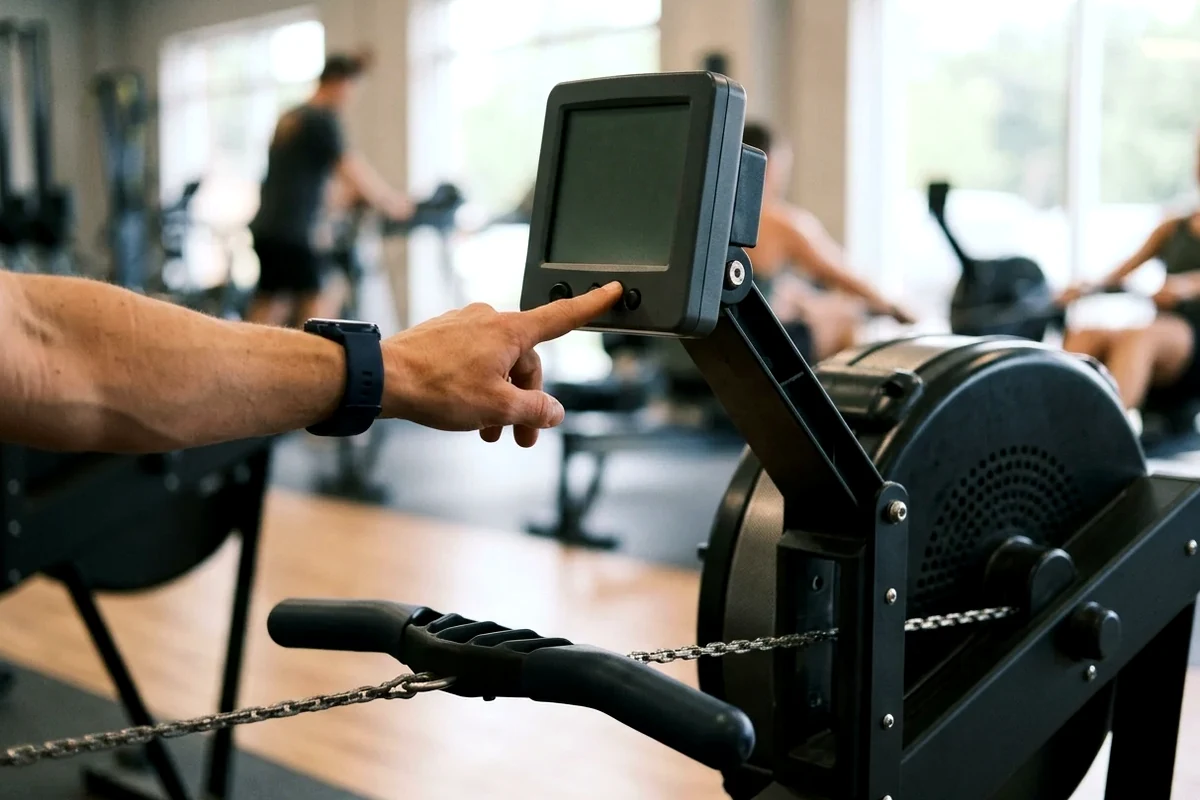
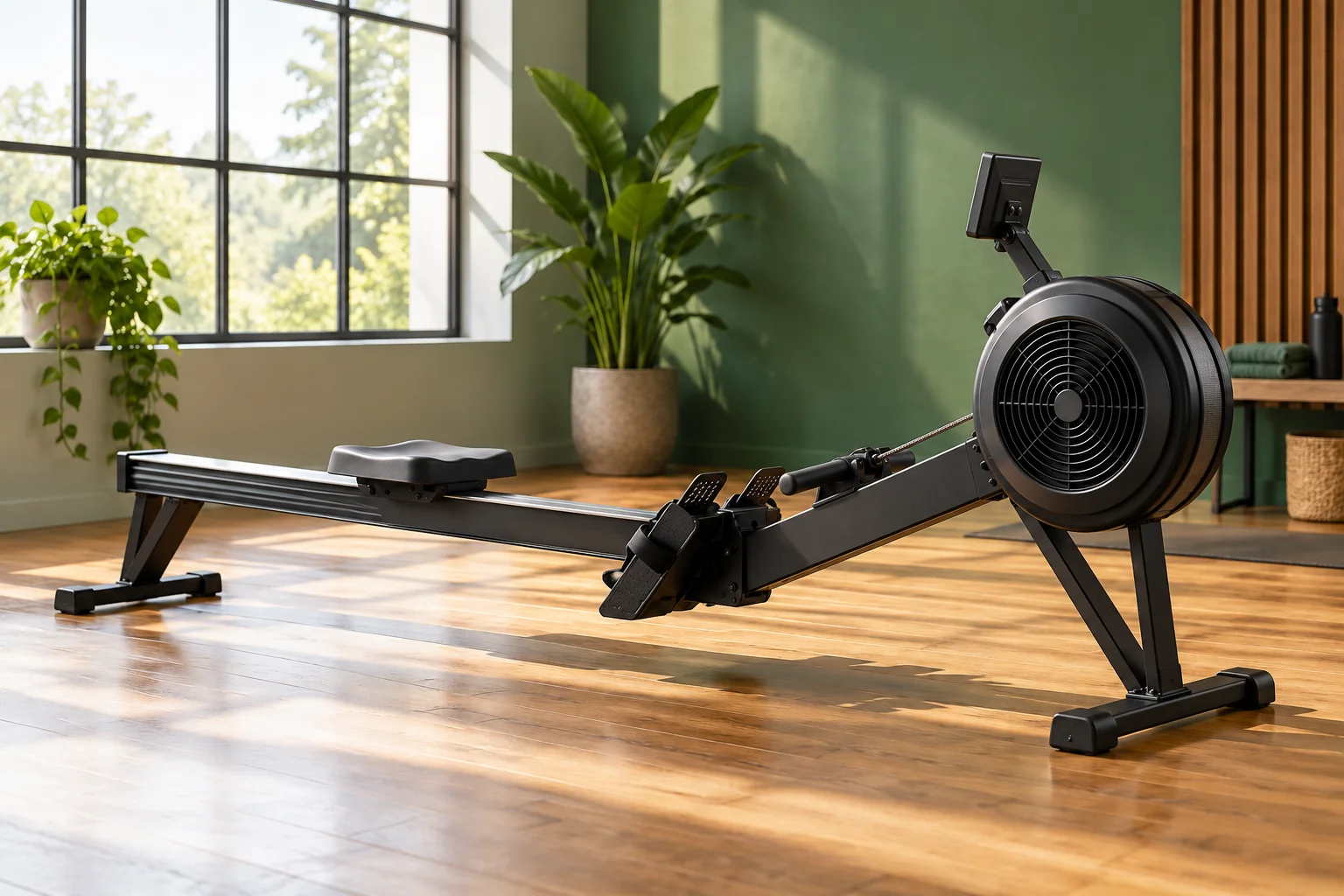
On an air-resistance ergometer, the damper lever on the side of the flywheel housing is an airflow intake control rather than a direct measure of workout intensity. The Concept2 flywheel housing damper lever is numbered 1–10 to control airflow (recommended starting setting 3–5, with 1–4 feeling like a sleek racing shell), and between strokes the PM measures flywheel deceleration (drag factor) to self-calibrate true work regardless of damper setting. At sea level, a brand new Concept2 RowErg has a drag factor of 90 or less at damper setting 1 and 200 or more at damper setting 10, whereas a new SkiErg ranges from 55 or less (damper 1) to 150 or more (damper 10) and a new BikeErg ranges from 45 or less (damper 1) to 225 or more (damper 10).
Once drag is measured on each recovery phase, the monitor links split pace and mechanical power through an exact cubic physical equation. Concept2 Performance Monitors calculate mechanical power in watts from pace using the formula watts = 2.80/pace³, where 2.80 is a constant and pace is time in seconds over distance in meters. Concept2 Performance Monitors calculate pace (time in seconds over distance in meters) from mechanical power in watts using the inverse cubic formula pace = ³√(2.80/watts). Concept2 Erg Pace Calculator relates distance (meters), 500m split (seconds), cumulative time (seconds), and watts using distance = (time/split) * 500, split = 500 * (time/distance), time = split * (distance/500), and watts = 2.8/(split/500)³.
Because power scales inversely with the cube of split pace, small reductions in split time require large increases in mechanical wattage:
- Pace-to-watts worked calculation: At a 2:05/500m split (125 seconds per 500 meters, or a 0.25 pace), Concept2 calculates power as
2.80/0.25 ^ 3 = 2.80/0.015625 = 179.2watts. - Distance and split duration: Rowing a distance of 2000 meters at a 1:50 per 500m split requires a cumulative time of 7:20.
- Non-linear cubic watt jumps: Because Concept2 mechanical power scales inversely with the cube of split time (
Watts = 2.80 / (Split (seconds) / 500)³), a 2:00.0/500m split equals 202.5 W and dropping 10 seconds to 1:50.0/500m (263.0 W) requires +60.5 W (+29.9% power), whereas dropping 10 seconds from 1:40.0 (350.0 W) to 1:30.0 (480.1 W) requires +130.1 W (+37.2% power). - World Ranking distance medians: In Concept2 2026 Season World Rankings (May 1, 2025 – April 30, 2026), the overall 50th-percentile (median) pace across 10,198 ranked 2,000m rowers is 1:58.7 /500m (7:55.0 total, 209.2 W), the 5,000m median pace is 2:06.6 per 500m (21:06.3 total, 172.5 W), and the 10,000m median pace is 2:09.3 per 500m (43:06.3 total, 161.9 W).
- External mechanical work in kilojoules: External mechanical work in kilojoules is calculated from average mechanical power in watts and duration in seconds as
External work (kJ) = average power (W) × duration (s) ÷ 1,000(for example,100 W × 600 s ÷ 1,000 = 60 kJof external work), because watts are joules per second.
| Split or Ranking Benchmark | Mechanical Power and Time Relationship | Source Context |
|---|---|---|
| 2:05/500m split (125 seconds per 500 meters, 0.25 pace) | 2.80/0.25 ^ 3 = 2.80/0.015625 = 179.2 watts |
Concept2 Watts Calculator worked example |
| 1:50 per 500m split over 2000 meters | Cumulative time of 7:20 | Concept2 Erg Pace Calculator example |
| 2:00.0/500m (202.5 W) to 1:50.0/500m (263.0 W) | Dropping 10 seconds requires +60.5 W (+29.9% power) | Cubic split scaling (Watts = 2.80 / (Split (seconds) / 500)³) |
| 1:40.0/500m (350.0 W) to 1:30.0/500m (480.1 W) | Dropping 10 seconds requires +130.1 W (+37.2% power) | Cubic split scaling (Watts = 2.80 / (Split (seconds) / 500)³) |
| 2,000m, 5,000m, and 10,000m median splits | 1:58.7 /500m (7:55.0, 209.2 W) for 2,000m across 10,198 rowers; 2:06.6 (21:06.3, 172.5 W) for 5,000m; 2:09.3 (43:06.3, 161.9 W) for 10,000m | Concept2 2026 Season World Rankings (May 1, 2025 – April 30, 2026) |
To compare your own split targets across race distances, review our guides on good rowing pace by distance and the rowing pace chart.
How the Adult Compendium Separates Rowing METs from Walking Steps
Because mechanical wattage spans a wide range across common splits, physiological oxygen cost changes just as sharply. The 2011 Compendium of Physical Activities (Ainsworth) contains 821 codes for specific activities, with 68% (561/821) having measured MET values. The 2024 Adult Compendium of Physical Activities (Herrmann, tailored for adults 19-59 years of age by removing data from those >=60 years) screened 32,173 abstracts and 1507 full-text papers to extract 2356 values from 701 papers, compiling 1114 physical activities (912 with measured MET values and 202 with estimated values) across 22 Major Headings.
Rather than assigning stationary rowing a single fixed multiplier, the Adult Compendium of Physical Activities stratifies rowing across five distinct activity codes by wattage and effort:
- Code 02070 (general vigorous effort): In the Adult Compendium of Physical Activities, Code 02070 (Rowing, stationary ergometer, general, vigorous effort) is assigned 7.0 METs in 1993 and 2000, 6.0 METs in 2011, and 7.3 METs in 2024.
- Code 02071 (<100 watts, moderate effort): In the Adult Compendium of Physical Activities, Code 02071 (Rowing, stationary ergometer, general, <100 watts, moderate effort) is assigned 3.5 METs in 1993 and 2000, 4.8 METs in 2011, and 5.0 METs in 2024.
- Code 02072 (100 to 149 watts, vigorous effort): In the Adult Compendium of Physical Activities, Code 02072 (Rowing, stationary, 100 to 149 watts, vigorous effort) is assigned 7.0 METs in 1993, 2000, and 2011, and 7.5 METs in 2024.
- Code 02073 (150 to 199 watts, vigorous effort): In the Adult Compendium of Physical Activities, Code 02073 (Rowing, stationary, 150 to 199 watts, vigorous effort) is assigned 8.5 METs in 1993, 2000, and 2011, and 11.0 METs in 2024.
- Code 02074 (≥ 200 watts, very vigorous effort): In the Adult Compendium of Physical Activities, Code 02074 (Rowing, stationary, ≥ 200 watts, very vigorous effort) is assigned 12.0 METs in 1993, 2000, and 2011, and 14.0 METs in 2024.
Level walking operates across a much narrower metabolic range. In the Adult Compendium of Physical Activities, level walking MET values scale with walking speed: Code 17151 (<2.0 mph, very slow) is 2.0 to 2.3 METs; Code 17152 (2.0 to 2.4 mph, slow pace) is 2.5 to 2.8 METs; Code 17170 (2.5 mph, firm, level surface) is 3.0 METs; Code 17190 (2.8 to 3.4 mph, moderate pace) is 3.3 to 3.8 METs; Code 17200 (3.5 to 3.9 mph, brisk) is 3.8 to 4.8 METs; and Code 17220 (4.0 to 4.4 mph / 6.4 to 7.0 km/h, very brisk) is 4.0 to 5.5 METs.
Published step-count and cadence studies link these walking MET tiers to daily step volumes:
- Moderate-intensity cadence heuristic: Across 38 studies (11 controlled, 18 free-living observational, and 9 intervention), Tudor-Locke establishes that a walking cadence of ≥100 steps/min is a consistent heuristic value associated with absolutely defined moderate intensity (3 METs) in adults, whereas mean daily population cadence is 7.7 steps/min with 13.5 hours/day spent below 60 steps/min.
- Habitual daily step translations: Tudor-Locke reports that healthy adults typically take between 4,000 and 18,000 steps/day (making 10,000 steps/day reasonable), that 100 steps/minute multiplied by 30 minutes produces a minimum of 3,000 moderate-intensity steps, and that computed daily translations including habitual activity equate to 7,100 to 11,000 steps/day (or 7,000-8,000 steps/day by direct free-living monitoring).
- Origin and step-count zones: Tudor-Locke notes that the 10,000 steps/day slogan is traceable to the 1960s in Japan, that ≥30 minutes of moderate-intensity daily activity translates to 3000-4000 steps if those steps are at least moderate intensity (≥100 steps/min), accumulated in at least 10-min bouts, and taken over and above a sedentary baseline, and defines five adult step zones: <5000 (sedentary), 5000-7499 (low active), 7500-9999 (somewhat active), ≥10,000-12,499 (active), and ≥12,500 steps/day (highly active).
- Perceived exertion and speech check: The CDC relative-intensity scale places moderate effort at 5–6/10 and vigorous effort beginning at 7–8/10, with a speech check distinguishing conversation without singing (moderate) from being limited to a few words between breaths (vigorous).
Why Online Step Conversion Charts Produce Conflicting Minute Totals
The core failure mode in workplace step challenges occurs when programs convert non-ambulatory activities into steps using different baseline assumptions for rowing intensity and walking cadence. Health Enhancement Systems (HES) Step Conversion Chart explicitly notes that steps/minute values are estimates rather than actual steps, and that for nonstep activities step equivalents are determined by metabolic cost (higher intensity = more steps/minute), while stationary bicycling at 90-100 watts is assigned 181 steps/min.
Because each institution selects its own metabolic baseline, five published conversion resources produce starkly different step totals per minute of rowing:
- Public Employees Health Program (PEHP): PEHP Activities to Steps Conversion Chart assigns 111 steps/minute to Rowing machine, moderate and 189 steps/minute to Rowing machine, vigorous, alongside 76 steps/minute for Walking 2 mph, 100 steps/minute for Walking 3 mph, 152 steps/minute for Walking 4.0 mph, 178 steps/minute for Running a 12-minute mile, 222 steps/minute for Running a 10-minute mile, and 278 steps/minute for Running an 8-minute mile.
- South Eastern Health and Social Care Trust (HSCNI): South Eastern Health and Social Care Trust (HSCNI) Step Conversion Chart (adapted from HealthPartners, Inc.) assigns 75 steps per minute to Rowing, leisurely, 150 steps per minute to Rowing, moderately, and 289 steps per minute to Rowing, heavy, alongside 185 (Running 8 kmph), 230 (Running 9.5 kmph), 305 (Running 13 kmph), and 350 steps per minute (Running 16 kmph).
- Boston University Human Resources: Boston University HR Activity to Steps Conversion Chart (citing America on the Move, Healthy Steps to Albany, and Concordia Plan Services) assigns a single constant of 212 steps/min to Rowing machine and 147 steps/min to Rowing, alongside 61 steps/min for Walking, stroll, 84 steps/min for Walking, average, 178 steps/min for Running a 12-minute mile, 222 steps/min for Running a 10-minute mile, and 278 steps/min for Running an 8-minute mile.
- Health Enhancement Systems (HES): Health Enhancement Systems (HES) Step Conversion Chart assigns 186 steps/min to Rowing machine, moderate and 226 steps/min to Rowing machine, vigorous, while assigning 74 (Walking 2.0 mph), 93 (Walking 3.0 mph), 114 (Walking 3.5 mph), 133 (Walking 4.0 mph), 213 (Running 5 mph / 12-min mile), 261 (Running 6 mph / 10-min mile), 293 (Running 7 mph / 8.5-min mile), 314 (Running 8 mph / 7.5-min mile), and 340 steps/min (Running 9 mph / 6.5-min mile).
- Stepsly net-MET model: Stepsly Rowing to Steps Converter assumes Rowing Machine (moderate, 100 watts) at 7 MET and moderate walking at 3 mph at 3.5 MET (for a 154 lb person and a 5 ft 9 in walker at 111 steps/minute), using net METs
(7 - 1) / (3.5 - 1) x 35to equate 35 minutes of rowing (245 active calories) to 84 minutes of walking or 9,316 steps (and 15 min = 36 min walking = 3,992 steps, 30 min = 72 min walking = 7,985 steps, 60 min = 144 min walking = 15,970 steps).
Consequently, a rower who asks how many minutes on the ergometer equal a daily step target must first check which institutional chart or net-MET model governs their challenge log.
Why Fixed Stroke Targets Cannot Be Converted Without Stroke Rate and Power
Short fitness challenges frequently assign a fixed stroke target as a daily movement substitute, but stroke count alone specifies neither total session time nor mechanical work per stroke. The Concept2 Calorie Calculator adjusts hourly energy expenditure for body weight using the formula True Calories/hour burned = Calories on the PM - 300 + (1.714 * weight) and total workout burn = (True Calories/hour burned * duration in seconds)/3600.
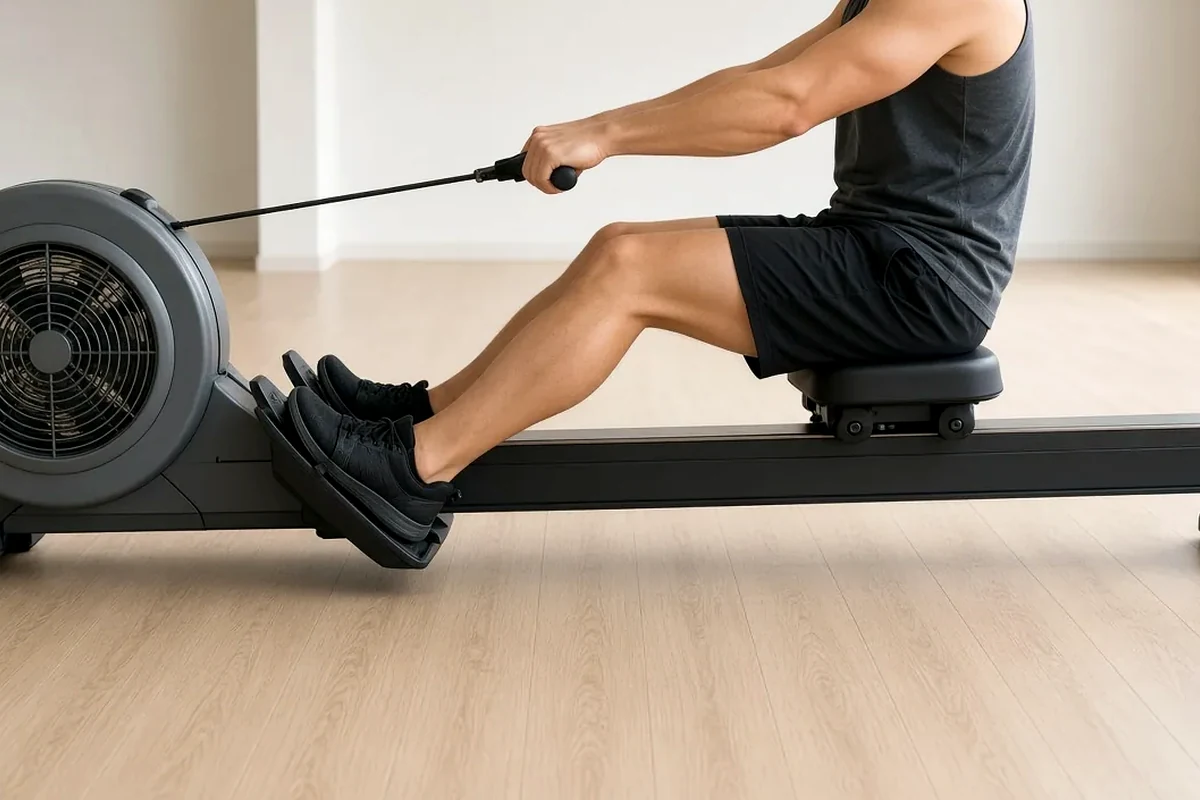
Session duration and flywheel behavior during any stroke-count workout depend on cadence (spm) and drive force:
- Cadence tiers by workout type: Concept2 stroke rate guidelines classify 18-22 spm for technique and rhythm practice (where the flywheel slows down more between strokes), 24-28 spm for longer steady-state workouts, 30-36 spm for interval training and racing distances up to 2000 meters, and 38+ spm for short-distance racing (up to 47 spm in World Rowing Championships finishes).
- Low-rate monitor behavior and slide drills: When rowing at very low stroke rates below 15 spm, the Concept2 Performance Monitor may start incorrectly registering high stroke rates; low-rate slide control drills use rates such as below 22 spm while sprint drills use rates such as 36+ spm, and a half-slide drill asks whether you can comfortably row half slide at 30 spm.
To see how cadence and split targets structure complete ergometer sessions, consult our guides to different rowing machine exercises and beginner rowing workouts.
Indoor Rowing vs Running: Pace Benchmarks, MET Tiers, and Body-Weight Calorie Adjustments
Athletes comparing indoor rowing vs running face two distinct conversion problems: how an ergometer split relates to track running pace, and how body weight alters Calorie expenditure between weight-bearing running and seated rowing.
Pace and MET Comparison Between Rowing and Running
In track and ergometer cross-training, Concept2 notes that a runner’s 400m track lap time loosely correlates with a 500m rowing split and compares it against running pace per mile:
- Split-to-mile and track-lap correlation: Concept2 compares rowing 500m split to running pace per mile (where a 6:00/mile is faster than an 8:00/mile): the Olympic rowing race distance is 2000m (four 500m segments, requiring a 2:00/500m average split to break 8 minutes), a runner’s 400m track lap time loosely correlates with a 500m rowing split because a boat glides over water, and familiar erg benchmarks include a 1:45/500m split, an 800-watt stroke, or burning 450 Calories.
- Track workout equivalents and long-distance benchmarks: Concept2 notes that in track workouts where runners use a 400m lap, 500m is an approximate rowing equivalent (such as 4 x 500m with 1 minute rest at 28–36 spm), a comfortable 5k aerobic row targets 24–26 spm, and long-distance benchmarks include half marathon (21,097m) and full marathon (42,195m), while emphasizing that running and rowing workouts are not an exact comparison because comparisons favor the primary sport, rowing is more technique-driven, and rowing glides each step.
- Running MET progression by speed: In the Adult Compendium of Physical Activities, running MET values scale with speed: Code 12020 (Jogging, general) is 7.0 to 7.5 METs; Code 12030 (Running, 5.0 to 5.2 mph / 12 min/mile) is 8.0 to 8.5 METs; Code 12050 (Running, 6–6.3 mph / 10 min/mile) is 9.3 to 10.0 METs; Code 12070 (Running, 7 mph / 8.5 min/mile) is 11.0 to 11.5 METs; Code 12080 (Running, 7.5 mph / 8 min/mile) is 11.5 to 12.5 METs; and Code 12120 (Running, 10 mph / 6 min/mile) is 14.5 to 16.0 METs.
| Activity Modality and Compendium Code | Speed or Power Tier | Published MET Value Range |
|---|---|---|
Stationary rowing (02070) |
Rowing, stationary ergometer, general, vigorous effort | 7.0 METs in 1993 and 2000, 6.0 METs in 2011, and 7.3 METs in 2024 |
Stationary rowing (02071) |
Rowing, stationary ergometer, general, <100 watts, moderate effort |
3.5 METs in 1993 and 2000, 4.8 METs in 2011, and 5.0 METs in 2024 |
Stationary rowing (02072) |
Rowing, stationary, 100 to 149 watts, vigorous effort |
7.0 METs in 1993, 2000, and 2011, and 7.5 METs in 2024 |
Stationary rowing (02073) |
Rowing, stationary, 150 to 199 watts, vigorous effort |
8.5 METs in 1993, 2000, and 2011, and 11.0 METs in 2024 |
Stationary rowing (02074) |
Rowing, stationary, ≥ 200 watts, very vigorous effort |
12.0 METs in 1993, 2000, and 2011, and 14.0 METs in 2024 |
Level walking (17151, 17152, 17170, 17190, 17200, 17220) |
<2.0 mph (17151), 2.0 to 2.4 mph (17152), 2.5 mph (17170), 2.8 to 3.4 mph (17190), 3.5 to 3.9 mph (17200), 4.0 to 4.4 mph / 6.4 to 7.0 km/h (17220) |
2.0 to 2.3 METs (17151), 2.5 to 2.8 METs (17152), 3.0 METs (17170), 3.3 to 3.8 METs (17190), 3.8 to 4.8 METs (17200), 4.0 to 5.5 METs (17220) |
Running (12020, 12030, 12050, 12070, 12080, 12120) |
Jogging general (12020), 5.0 to 5.2 mph / 12 min/mile (12030), 6–6.3 mph / 10 min/mile (12050), 7 mph / 8.5 min/mile (12070), 7.5 mph / 8 min/mile (12080), 10 mph / 6 min/mile (12120) |
7.0 to 7.5 METs (12020), 8.0 to 8.5 METs (12030), 9.3 to 10.0 METs (12050), 11.0 to 11.5 METs (12070), 11.5 to 12.5 METs (12080), 14.5 to 16.0 METs (12120) |
For a mechanical and joint-loading comparison between seated ergometers, see our technical note on rowing machine versus exercise bike calorie and joint comparison.
Body-Weight Adjustments for Rowing and Running Calorie Calculations
When athletes compare Calorie burn between an indoor rower and a run or walk, Concept2 Performance Monitors calculate Calories using a formula based on a 175 pound (79.5 kg) individual, so the Concept2 Calorie Calculator should be used to better approximate Calories for other body weights.

To compare monitor displays and metabolic Calorie estimates accurately across body weights, apply the following verified rules and peer benchmarks:
- Required inputs for Concept2 Calorie adjustment: Using the Concept2 Calorie Calculator requires three inputs: body weight, average Calories/hour burned for the entire workout from the PM workout summary (not the last stroke/pull), and workout duration.
- Weight-adjusted Calorie equation: Concept2 Calorie Calculator adjusts hourly energy expenditure for body weight using the formula
True Calories/hour burned = Calories on the PM - 300 + (1.714 * weight)andtotal workout burn = (True Calories/hour burned * duration in seconds)/3600. - Single Calorie countdown workouts: On a Concept2 PM5, a Single Calorie Workout can be programmed for a target number of Calories (such as 20, 50, or 70), counting down to zero and displaying finish time to the tenth of a second.
- On-water weight adjustment factor (
Wf): Concept2 Weight Adjustment Calculator estimates potential speed in an eight usingWf = [body weight in lbs / 270]raised to the power.222(having changed from an original 170 lb average rower baseline to 270 lbs), withCorrected time = Wf x actual time (seconds)andCorrected distance = actual distance / Wf. - Watta 30-minute running vs rowing comparison: Watta rowing-vs-running guide estimates that for a 75 kg person over 30 minutes, running at 6:00/km (10 km/h) burns about 414 kcal and at 5:00/km (12 km/h) burns about 489 kcal (via the ACSM running equation), while rowing at a 2:20/500m split burns about 361 kcal (333 kcal at 60 kg; 390 kcal at 90 kg), at 2:05/500m burns about 450 kcal, and at 2:00/500m burns about 490 kcal (via the Concept2 monitor formula with weight correction).
- Nutrola 155-pound (70 kg) MET comparison: Nutrola compares Running at 9.8 METs (6 mph, 10-minute mile) with Rowing at 7.0 METs (moderate effort) using
calories = METs x body weight in kg x duration in hours: for a 155-pound (70 kg) person, 30 minutes burns 345 calories running (689 cal/hr, 11.5 cal/min) vs 246 calories rowing (492 cal/hr, 8.2 cal/min). - Garage Gym Reviews (Harvard Health) 155-pound comparison: Garage Gym Reviews (citing Harvard Health) states that a 155-pound person burns around 252 calories in 30 minutes of moderate rowing and 369 calories in 30 minutes of vigorous rowing, compared with 360 calories running at a 10-minute mile pace, 450 calories at an 8-minute mile pace, and 562 calories at a 6-minute mile pace.
| Comparison Source and Athlete Mass | 30-Minute Indoor Rowing Calorie Estimate | 30-Minute Running Calorie Estimate |
|---|---|---|
| Watta guide (75 kg athlete over 30 minutes, with 60 kg and 90 kg comparisons) | 361 kcal at 2:20/500m split (333 kcal at 60 kg; 390 kcal at 90 kg), 450 kcal at 2:05/500m, and 490 kcal at 2:00/500m | 414 kcal at 6:00/km (10 km/h) and 489 kcal at 5:00/km (12 km/h) |
| Nutrola MET model (155-pound / 70 kg athlete over 30 minutes) | 246 calories at 7.0 METs moderate effort (492 cal/hr, 8.2 cal/min) | 345 calories at 9.8 METs, 6 mph / 10-minute mile (689 cal/hr, 11.5 cal/min) |
| Garage Gym Reviews citing Harvard Health (155-pound athlete over 30 minutes) | 252 calories at moderate pace and 369 calories at vigorous pace | 360 calories at a 10-minute mile pace, 450 calories at an 8-minute mile pace, and 562 calories at a 6-minute mile pace |
Pre-Conversion Variable Checklist
Before converting an indoor rowing session into step equivalents, stroke targets, or running Calories, confirm whether these three primary variables are known from your workout log:
- Mechanical power output: Do you know the average mechanical power or split pace recorded on the performance monitor for the session?
- Active rowing duration: Do you know the exact elapsed rowing time (excluding rest intervals) or the stroke rate used to complete a fixed stroke count?
- Athlete body weight: Do you know the rower’s body weight for adjusting monitor Calorie totals or scaling metabolic oxygen cost?
Sources
- Concept Indoor Rower — Pace and Mechanical Power Technical Documentation
- Concept Indoor Rower — Explaining the Flywheel Drag Factor and Damper Setting Guide
- Concept Indoor Rower — Calorie Expenditure and Weight Adjustment Factor Reference
- Adult Compendium of Physical Activities — Stationary Conditioning, Walking, and Running Tables
- International Journal of Behavioral Nutrition and Physical Activity — Adult Step Volume Reference Study
- British Journal of Sports Medicine — Adult Walking Cadence Threshold Study
- Public Employees Health Program — Step It Up Activity Conversion Chart
- South Eastern Health and Social Care Trust — Step Conversion Chart
- Boston University Human Resources — Activity to Steps Conversion Table
- Health Enhancement Systems — Activity Step Conversion Chart
- Stepsly — Stationary Rowing to Steps Conversion Reference
- CrossFit and Watta — Indoor Rowing and Running Pace Conversion Guides
- Nutrola and Garage Gym Reviews — Stationary Rowing and Running Calorie Reference Tables